Showing posts with label producer. Show all posts

Monday, September 8, 2014

Always learning, sharing knowledge

In Honduras, and especially in rural La Unión, the agriculture industry sustains the population with crops for personal consumption and to sell for income. Nearly everyone in La Unión and the surrounding villages (aldeas) is connected in some way to the main crops here: coffee, corn and beans. Unfortunately, agriculture is not always a sure source of income for a family: crop yields can be hurt by bad weather and disease. While these problems cannot be prevented completely, their effects can be mitigated through agricultural knowledge and training on various methods of field management. This training not only helps prevent diseases, but also helps farmers improve their harvests and better manage the income they receive from their fields.

Gilberto works with farmers to
help them improve their harvests.
This is where Gilberto comes in. Gilberto Barrientos Hernández has been a field manager at Unión MicroFinanza for the past 5 years, guiding farmers in improving their crop quality and harvest, and leading agricultural training programs such as the Coffee Farmer School (read more about Coffee Farmer School in our newsletter). As a La Unión native who has been working in agriculture since early childhood, Gilberto has gained invaluable knowledge and build strong relationships in the communities. He also manages his own farm and home garden in La Unión with the help of his wife and three children. Equipped with his experiences and knowledge, Gilberto travels to individual farms in the region every week to demonstrate techniques for improving the harvest.

Besides working with farmers in official training sessions, Gilberto is continually questioning, learning and sharing his knowledge with others. UMF staff members look to Gilberto as the resident expert on all things plant related. He not only can identify many of the plants he encounters, he can also tell of their properties and uses. If he isn’t familiar with a certain plant, he tucks a sample into his backpack to bring home and inquire about it. Gilberto is an essential part of UMF not only for his knowledge, but also for the relationships and trust he has formed in the communities.

Gilberto’s three children attend the bilingual school in La Unión, and they enjoy translating for visiting groups. They dream about receiving higher education and starting their careers, and Gilberto hopes the same for them as he works to help them fulfill these dreams.

We value Gilberto and his work, and want to support him with a sustainable income so he can provide for his family’s daily necessities, for his children to receive a quality education, for improving his home, and for health care. Your donations to UMF help support farmer training programs, as well as the employees like Gilberto who lead them. Find out more on our website about becoming a donor. Thank you for your partnership with Unión MicroFinanza and the people of Honduras!

Monday, February 24, 2014

Relationships renewed and begun

Written by Sally Wevers, who led a team from Calvary Church in Holland, Michigan, on a visit to La Unión from Feb. 11 to 18. 

An eight person team recently returned from La Unión, Honduras. Despite different ages, backgrounds, experiences, and viewpoints, the group bonded extremely well. The Unión MicroFinanza staff did an amazing job setting up the schedule, as we were able to spend time with farmers, families, students at Abundant Life school, and individuals in La Unión.

The trip was unique in that it took place during coffee harvest, and we were able to receive and process Marlon Carcamo's (Calvary's coffee provider) coffee cherries. We picked coffee, unloaded 150-pound bags of fresh coffee cherries, processed them through the beneficio, hand sorted, stirred beans in the solar dryer, smelled, tested and tasted coffee.

We had times of reflection, devotions, and debriefing, sharing, and challenge. In order to share so many thoughts from the team, we are listing some observations, impacts, and responses. We hope you enjoy reading about what we have learned.

Observations:
- There is extreme poverty next to spectacular beauty, and the two extremes painfully clash.
- Calvary's coffee farmer, Marlon Carcamo, was thrilled and honored to have North Americans pick in his field and have lunch in his home with his family. But, the honor was ours.
- Our hearts hurt for the difficult physical labor and efforts placed on our farmer friends, so painfully affected by a leaf rust fungus that was no fault of their own. The fungus destroyed major portions of the coffee fields for many farmers. Knowing the families, having faces with names, brings authentic sadness and concern to the team. Our prayers will now be more intentional for them.
-"It is unfair that they work so hard and their provision for food is wiped out. The unfairness makes me mad!  I don't think I will complain when I get my Saturday chore list anymore," shared by the youngest member of our team.
- Physical provisions for families have been negatively affected, but there is more. Education for many has been taken away. We spent limited time in Nueva Paz -- this is where a team helped to build water collection systems called pilas two years ago. Eight children could be named from this one small community who had to quit their local school for lack of $15 per student for the semester!

Impacts:
- We are committed to purchasing the Aldea Coffee at church, and sharing our experience with others. The choices we make at home do dramatically impact others.
- We are partnering with an amazing organization in La Unión. The Unión Microfinanza (UMF) staff is committed to change. One of the staff members shared this with us, "Coffee is the thing we do to partner with and provide change. It could have been tea, or something else. The driving passion we have is the people, not the product."
- The UMF staff has the wisdom and the education to teach and replicate supplies needed to create smaller scale beneficios for area farmers. This training continues to have ripple affects in the community. We are grateful for Calvary's partnership with this organization.
- The team was challenged to attain more responsible personal stewardship, to consider what "living with less" might look like, to realize a growing appreciation for UMF's tremendous commitment to La Unión, and we experienced a greater appreciation for the education offered at Abundant Life school. The spiritual maturity of high school students was a powerful witness to us.

Most, if not all of us, have been asked,"Why go on a mission trip?" This is a summary of our answers. It is not about how much work that could be accomplished, but rather it is about relationships renewed, and others begun. It is not about what we could teach them, but what they had to teach us. When we now know names with faces, people matter. What they do and need matters, and responding to needs brings Christ-centered joy. Mission trips motivate personally and communally. Step out of your comfort zone. Mission trips are addictive!

Monday, January 13, 2014

A new approach at the UMF beneficio


We’re firing up the depulping machine at the UMF beneficio in La Unión, ready for the 2014 coffee harvest! This year will look a little different at the beneficio – let us tell you what’s new and what we hope to accomplish through the changes we’ve made.

Each year, we learn more about coffee processing and how to better achieve our goals of quality, training, and environmental sustainability. The 2013 harvest season saw successes in all three of these areas, but we want to improve on it by making changes for the 2014 harvest.

The biggest change we’ve made is that only four different farmers will process their coffee at the UMF beneficio this year. These farmers were pre-selected based on their participation in previous years at the beneficio and in our microloan program. The main idea for having only four farmers each year is to ensure that we are able to provide the best training experience possible, so that they will be able to replicate and continue processing high quality coffee on their own in future years.

The fermentation tanks get tiling after being split in half.
In addition, we (UMF) and the farmers will be better able to manage how much coffee is coming to the beneficio for processing, and when. Each of the four farmers will be assigned an entire solar dryer and two fermentation tanks (we modified our previous tanks to divide them in half and create eight tanks in total). Farmers will be in charge of managing this equipment, so they will know before they pick coffee if they have room at the UMF beneficio to process, ferment, and dry it. Through this experience, farmers will learn about managing the coffee processing at their own beneficios in the future.


By working in-depth with four farmers during this harvest, we will also be able to visit coffee farms on the day of picking and offer on-site advice on picking quality coffee. High quality picking is one of the areas that we have identified as having the greatest impact on final quality, so this will benefit the farmers (who will get a higher price for better quality) as well as consumers, who will get even better coffee at the end of the day.

Also, we’ll require farmers to spend at least 20 hours at the UMF beneficio to learn about the different processing stages that their coffee is going through, including receiving, fermentation and drying. This in-depth training is important to enable farmers to process their own coffee in the future. Since we also want to make sure that other farmers have the opportunity to receive this training in the future, we’re limiting the number of years that a farmer can process at the UMF beneficio.

All of these changes will continue to transform the beneficio into a stepping stone to farmers achieving their own coffee processing capabilities. Within the next few years, we are excited to see farmers graduate from the UMF beneficio and implement high quality, environmentally sustainable beneficios of their own. We will be posting updates throughout the harvest!

Thursday, October 31, 2013

UMF's 2012-2013 Coffee Transparency Report

At UMF, we believe that transparency is better than any particular certification. For this reason, we are proud to present our second annual Transparency Report, detailing all pricing for the coffees that we purchased from farmers in the 2013 coffee harvest. This report details how much coffee we purchased, which farmers we purchased from, what prices we paid directly to these farmers, and how to compare these to numbers reported by Fair Trade or direct trade coffees that report FOB pricing.

Coffee farmer Rudy Carcamo on his field.
Farmers in La Unión were hit doubly during the 2013 harvest, with large losses resulting from coffee leaf rust and prices dipping to three year lows when farmers were ready to sell coffee. Although most coffee buyers, including Fair Trade Certified coffee, dropped prices with the falling market price, UMF made the decision to maintain prices from the 2012 harvest. If the coffee is as good this year as last, why would we lower the amount of money that we pay to purchase it? This year, our average green coffee purchase price was $2.54 (it was $2.48 in 2012) and our average parchment purchase price was $1.59 (it was $1.81 in 2012). Over the same time period, the coffee market price dropped 73%.

We encourage you to read this Transparency Report and ask questions. There are many companies and organizations around the world that claim to be helping farmers through the prices they pay for coffee, including ourselves. Without transparency, it is impossible for you, the consumer, to make informed decisions. Once you have read our transparency report, look for transparent information from other socially conscious coffee companies so that you can make an informed decision on what you buy for your morning cup.

How we pay farmers

UMF receives purchased coffee from farmers.
Among the numbers you will see below is the price that UMF paid for parchment coffee, or coffee with the shell still attached (this is how the vast majority of farmers sell their coffee). UMF and coffee farmers signed contracts in La Unión at the time of purchase, and these contracts show the total amount paid to a farmer for his or her coffee. The parchment coffee price is the amount of money paid directly to the farmer, divided by the amount of coffee sold to us, and it is the most transparent representation of what farmers received for their coffee.

To make comparison easier, we also translate this number into an amount paid to farmer per pound of green coffee as well as FOB pricing. FOB pricing is the most common number given by companies who report what they pay for coffee. However, this number includes shipping, preparation, and taxes that was NOT paid to the farmer. This number is different for every coffee but, as seen below, was an average of $0.41/lb green for the coffees that we purchased during this harvest.

To learn more about how this parchment price differs from prices quoted by Fair Trade and other exporters, read our 2011-2012 Transparency Report.

The Basics
Gilberto and Pedro sample coffee to be roasted and cupped.
UMF received and cupped 86 different coffees from 47 different farmers in the 2013 harvest. From these candidates, we selected and purchased the best 50 coffees from a total of 33 farmers. Eleven of these farmers participate in UMF’s microloan and training programs. In all, we purchased a total of 67,284 lb of parchment coffee from farmers. Next, we sent the coffee to a processing center in Honduras to remove the parchment and prepare it for exporting. This left us with 42,408 lb of green coffee, ready to be exported to the United States and sold. 

The smallest amount of coffee that we purchased from a farmer was 103 lb of parchment coffee, and the largest amount was 5,201 lb of coffee. The highest price that we paid was $1.78/lb parchment, and the lowest price paid was $1.38/lb parchment. As a comparison with Fair Trade Certified prices, the highest FOB price we paid was $3.72 and the lowest FOB price paid was $2.43. For reference, the Fair Trade Certified FOB coffee price this harvest was between $1.60 and $1.78 the past year.

The Numbers
Here is UMF’s 2012-2013 coffee transparency information:


A note for the blends: the price per pound green to farmer and the FOB price are estimates because the coffees are mixed prior to processing. However, the parchment price is exact for each farmer’s coffee in the blend. The bolded prices for the blends give the average for the entire blend, and the bolded number for total exported represents the weight of the entire blend.

Contracts
Below, we’ve posted a sample contract to show how we purchase coffee from farmers (we’ve removed from the sample the part of the contract that includes personal financial details). The main parts of the contract are explained here:

  Código del Café (Coffee Code): A unique code assigned to each sample we receive.

  Cantidad (Amount): The amount of parchment coffee we purchased in qq, or quintales. (One quintal is 100 lb.)

  Oferta (Offer): The rate we offer for each carga of coffee. (One carga is 200 lb, and the price is listed in the Honduran currency: Lempira. 1 USD ~ 20 Lempira depending on daily exchange rate)

  Precio Contrato (Contract Price): The total price paid to the farmer -- the amount of coffee purchased multiplied by the rate offered. (Oddly, the standard practice is to list the amount of coffee in quintales, or multiples of 100 lb, and to make the offer per carga, or 200 lb. It’s a confusing system, and we didn’t invent it. The contract price takes this difference into account.)

  Firma (Signature): This contract was signed in UMF’s La Unión office by UMF Financial Officer Charles Heins.


For a glossary of terms in the transparency report, and to view last year's numbers, visit our 2011-2012 Transparency Report.

Tuesday, August 20, 2013

Conquering coffee leaf rust, one farm at a time

By Heather Farrell

The air cools as we pass through La Zona Alta – The High Zone – on our way to Pedro Mejia’s coffee farm. The Honduran village is appropriately named – we’re level with the clouds that still cling to the mountains across the valley, remnants of last night’s thunderstorm. My coworker, Pedro Hernández, guides the motorcycle carefully on the damp dirt roads. We’re meeting Mejia to walk his field with him and do a leaf analysis that will identify disease prevalence and nutrient deficiencies on his farm.

Pedro Mejia holds up a rust-affected leaf.
Mejia has worked with Unión MicroFinanza for years, participating in our microloan program and selling us his specialty-grade coffee. But Mejia’s past harvest, like so many in Central America, was affected by the outbreak of coffee leaf rust, known in Spanish as la roya. Now he wants advice on what to do about it.

Mejia knows about leaf rust: he has been to large, general trainings offered by engineers from coffee organizations in Honduras. But as for a specialist from any organization coming to his farm to show him what to do in practice? “Never,” Mejia says. His two fields are less than two acres each, and the larger organizations do not have the resources to visit small farms like these.

Unión MicroFinanza has begun individualized field trainings to meet this need. A majority of the farmers in this region own small lots; but each finca, or coffee farm, has different agricultural needs. Coffee leaf rust will not be brought under control through general trainings, or through educational materials offered at a price outside the budgets of most coffee farmers. Each farmer, no matter the size of their field, must know how to control and prevent the disease from spreading.

“Look, this is lempira – it’s resistant,” Mejia points to the rust-resistant coffee variety that’s full of leaves and easy to distinguish on an affected farm. Three-quarters of this finca is red catuaí, a variety known for its quality, but which is susceptible to leaf rust. Some of the plants are recovering from leaf rust and have a good number of leaves, some have only a few leaves hanging on, and some Mejia has already cut down because they were beyond recovery. Last harvest, only 50 percent of his red catuaí cherries ripened. The rest didn’t ripen because the plant didn’t have enough leaves to produce energy for ripening the fruit.

Mejia and Hernández conduct a leaf analysis of the farm.
Mejia plunges deeper into his field to show us more plants. I struggle to keep up, sliding on the loose earth, crashing through dead branches, and getting facefuls of spider webs and wet leaves. Hernández shows Mejia how to perform the leaf analysis – pick 100 leaves from different trees without looking at them. Then, they examine the sampling, and based on shape and color irregularities, determine what nutrients the plants lack and what diseases are present (leaf rust isn’t the only coffee plague: diseases like ojo de gallo can be just as damaging to leaves, and affect varieties resistant to rust.)

“We recommend you do the analysis each month. The purpose is to control roya through nutrition and vigilance, to see if it’s going down,” Hernández says.

After the analysis, we move down the road to Mejia’s second farm. Right away, we see the plants are dramatically different from those on his other field. These lush young trees are of the variety yellow catuaí. Already they are laden with green cherries. I haven’t seen branches of catuaí trees so full of coffee in a while. Seeing these beautiful young plants, I now understand why Mejia might consider stumping and replanting on his older field.

The trees on his other farm are 12 years old; they’re tall and already have most of their expected harvests behind them. Yes, it would be less time, work and money if they could recover from the leaf rust after a year. But the time and money put into fighting the disease and trying to re-grow leaves wouldn’t be worth it; it’d be better to wait the two years needed for a new plant to produce a harvest. And, as farmers are now fully aware, preventing a disease like leaf rust is much easier than fighting it off once it has settled in and done its damage.

I ask Hernández if leaf rust was so bad last harvest because it caught everyone off guard.

“Yes, the outbreak was a surprise, so there wasn’t a chance for prevention,” he says.

Mejia walks between rows of
red catuaí coffee plants.
With his yellow catuaí, Mejia is ahead of the leaf rust: he can make sure the young plants stay healthy, with all the nutrients they need to ripen their large harvest while fighting off any leaf rust attacks. If he sees the rust start to take hold, he can use preventative sprays before it damages the plants.

As for his older field, he will control the rust as well as he can and wait a year to see if the plants recuperate. Hernández recommends a prevention product based on the results of the leaf analysis (more than 50 percent of the sampled leaves showed rust), and calculates how much of it Mejia will need. He’ll be able to purchase the product with the help of a microloan from Unión MicroFinanza.

If the trees don’t recover, he will stump some trees and clear the rest to plant anew.

“But I want to replant with catuaí again. And maybe bourbon. They have good flavor and I don’t want to lose that,” Mejia says. This is exactly what Unión MicroFinanza hopes – that farmers will maintain diversity on their fields and keep coffee varieties such as catuaí and bourbon that result in more flavorful coffee. Through individualized trainings, farmers will receive the practical knowledge they need to overcome coffee leaf rust and produce a consistent harvest of high-quality coffee.

Monday, July 15, 2013

Notes from a coffee field training


By Kayli Horne

Our altitude is around 1,550 meters as we pull up to Rigoberto Paz’s finca. I have made the ascent on the back of Pedro’s moto, passing waterfalls, clouds, and two aldeas, Chimizal and El Sitio, along the way.

Rigoberto prunes a coffee tree.
Gilberto pulls out his phone to call Rigo to let him know we’ve arrived, but he laughs because we can hear his phone ringing in the distance. We make our way through the rows of coffee trees, guided by Rigo’s whistles, and find him, machete in hand, among a section of newly planted coffee trees.

Rigo tells me he has owned his farm for fifteen years and has sold his coffee to Unión MicroFinanza the last three years. Patrick, UMF’s president, had told me that Rigo’s coffee last season was especially delicious—in each cup there were chocolatey-mango flavors. I feel privileged to be here at his finca, where the warm, liquid deliciousness I enjoy in the morning originates.

We start with pruning the farm. Gilberto tells me that although it seems counterintuitive, a coffee tree should not have as many hijos, or branches, as naturally grow; optimally, each tree should only have 2-3 hijos growing from the trunk. This is so that the leaves can get sufficient air and sunlight. If there are too many branches, the tree will actually produce less coffee, because there isn’t enough energy being allocated to cherry production and nourishment.

The section of the finca we’re working on is only two months old, and already there are up to seven hijos branching off. “Qué lastima,” or “what a pity,” Gilberto laments, as he cuts off five hijos from the tree. His face cringes, as if he can feel the plant’s pain. His love for coffee farming runs deep; he tells me he learned much of his knowledge about diseases and caring for the farm from his father. 
Light sprinkles of rain come and go throughout the morning. Pedro and Gilberto help Rigo prune about six rows of coffee trees. I ask Rigo how much time it will take him to do the whole farm. He says it will take him a week to prune half of a manzana (that’s a little less than an acre). 

Pruning, however, is just one of the basic practices that UMF covers in its trainings. Next, Gilberto and Pedro teach Rigo how to identify diseases and nutritional deficiencies. We assess the health of the farm by analyzing 100 leaves chosen without bias from different trees and parts of the farm. Pedro holds up each leaf one by one and identifies if there is a deficiency or disease. Rigo records the results in the UMF libreta, or notebook, in which he can continue to document leaf analyses every month.

Rigoberto and Gilberto record results from the leaf analysis.
As we’re finishing up the 100-leaf sample, the sun comes out, which if you were wondering, is pretty intense in the tropics at 1,550 meters. Ten of the leaves have roya, or coffee leaf rust, 20 have ojo de gallo, or chicken’s eye, and a handful have nutritional deficiencies. The verdict? Rigo makes plans to fumigate later this week with cobra verde to limit the spread of the diseases, so the leaves can continue to grow, making healthy plants and, in turn, more delicious coffee during this year’s harvest.

With personalized training sessions, not large-scale demonstrations or brochures, UMF makes the connection between current agricultural research and small-scale rural farmers. This is a relationship-based organization that is here for the long haul, not just to buy coffees during harvest or distribute microloans. The innovative farming techniques aim at improving the quality and increasing the quantity of the coffee, so the farmer can make more money during the harvest. This works toward our ultimate goal: enriching the lives of the people of the communities in which we work.

Thursday, June 13, 2013

Adonil's corn mill, one year later

Interviews by Gilberto Barrientos and Pedro Hernández

Adonil and Gilberto
Jose Adonil Tejada came to La Unión on Friday to pick up his microloan of fertilizer for his coffee farm. Last year, Adonil received a loan from UMF to purchase a corn mill to grind corn into flour for his family and the community of La Ceibita, where he lives. In the year since he was able to buy this mill, he has paid off the loan and has secured a small but steady income for his family from the mill.

Besides receiving money from other families using the mill, Adonil’s family saves money by being able to use their own mill instead of paying to use another. Currently, they have an average of four people from the community coming to use the mill each day. The price Adonil charges others to use the mill depends on how much corn they bring, but he said the average is about 3 lempiras per person. This means the family earns about 12 lempiras per day from the mill.

Twelve lempiras is about $0.60, which doesn’t seem like much. However, many families in the La Unión region live on less than $2 per day. To receive an extra income of 360 lempiras (about $18) per month is no small thing, especially if a member of the family needs medical care, new clothes or school supplies. In addition to this income, Adonil’s family saves about 90 lempiras per month by having their own corn mill, making their total income/savings 450 lempiras (about $22.50) per month.

Adonil has not had to spend anything on the mill for repairs because he and his family perform simple maintenance to care for it. They make sure water does not fall into the motor, and they clean the mill immediately after grinding corn. They also clean the band of the motor and use resin on it to keep it on track.

Adonil said that he and his family are very happy with the mill, and that it has been a good investment for them. He likes that it is easy to operate for him, his wife or his daughter. At UMF, we hope to continue offering access to microloans for processing equipment, through which farmers may support their families, as well as provide a service for their communities. 

Friday, January 18, 2013

Beneficio processes first coffee of 2012-2013 harvest

A chilly rain fell on La Unión yesterday afternoon as we gathered under the newly-built beneficio roof, wearing sweaters and raincoats and jumping up and down, partly to stay warm and partly out of excitement. We looked up in anticipation at every truck that passed: we were waiting for Alfredo Ponce to arrive with this year's first coffee for processing at the beneficio.

Everything was in place, and daylight was beginning to slip away. Then, at 5:30, a truck carrying coffee came up the new road to the beneficio. Alfredo jumped out of the truck and greeted us with a smile. We unloaded the bags and found them full of gorgeous, ripe coffee. It was time for the first run of our new sorting equipment, system for moving coffee, and fermentation tanks.

An hour an a half later, we finished processing. Alfredo, who processed coffee at our beneficio last year as well, stayed to see the new sorting mechanisms and other changes we'd made for this year. Despite being tired and wet after processing, we were very happy that the new density and size-sorting mechanisms worked beautifully and that coffee flowed through the system much better than last year. We still have small changes to make, but we are excited to have started processing coffee and we are looking forward to the next few months!

Here are a few pictures from the afternoon:

Alfredo Ponce (in orange) helps unload coffee at the beneficio.


The coffee, mostly of the variety IHCAFE 90, waits to move to the de-pulping machine after the floating cherries were skimmed off and the water drained.


We removed floating coffee and sent it to another tank to be collected separately. 


Alfredo brought us 25 gallons (about 750 lbs.) of coffee cherries from his farm, which is at an altitude of about 1,475 meters.


Alfredo watches his coffee go through the de-pulping and size-sorting machine.


A locally-made sorting machine separates de-pulped coffee from damaged coffee.


Monday, November 12, 2012

A cup of coffee with Noe Amaya

By Morgan Fett

The first time I saw Noe Amaya, I was a little distracted. I had just taken my first ride on the back of a motorcycle through the mountains of La Unión. Our Field Officer Gilberto brought me to the village of Nueva Paz to help examine pilas, large cement water cisterns, in various homes in the community. We were embarking on a community partnership project there, where a clean, fresh source of water was hours away.

Noe and his family.
A motorcycle ride through the mountains of western Honduras is the most breathtakingly beautiful experience. For a good hour or so afterwards it’s hard to snap out of the dreamy reverie it inspires. Noe, however, snapped me out of it right away. He was too expressive and too energetic to ignore. In many ways, Noe is the leader of Nueva Paz, a village that participates in our microloan program. He regularly lends his knowledge of construction, coffee, or various other skills to community members who need it. People stop by his house often, asking for advice or looking for a connection to some resource or person. Noe is the man to advise, to connect people, to lead. He had already built a pila in his own home, but he lent his knowledge to build pilas in other homes during the community partnership project. In typical Noe fashion, he offered his help in any way, and then ended up coordinating and leading most of the work.

Noe isn’t from La Unión. He’s from the state of Atlantida along the northern coast of the country, which makes his role as a leader in the insular community of Nueva Paz that much more impressive. He has a small coffee farm, or finca, that measures around 1.2 acres. His wife and three young sons help maintain and harvest his finca, making it truly a family affair. Noe cultivates his own field in addition to picking coffee on larger farms during the harvest, working on bean or corn farms, and taking on any construction job or odd job he can. Due to his unceasing energy, he turns this eclectic mix of exhausting work into a livelihood for himself and his entire family.

His passion, however, is his coffee field. From his small field he managed to grow a great coffee; his beans contribute to our Dark Roast. When you talk to Noe, you understand why he’s reaping great things from a tiny stretch of land. The word calidad - quality - threads through his conversation about coffee. “That’s my plan, growing a coffee of calidad...you can’t grow coffee without caring about its calidad...the goal of utilizing UMF’s resources is to increase the calidad of my coffee.” Because of this, I love listening to Noe talk about his coffee. He thinks critically about his harvest. He has a vision for his coffee - one of a specialty-grade product, one where the bottom line isn’t necessarily the money he can make from his harvest but rather the name he can make for himself as a producer of coffee. This combination of energy and vision makes me excited to follow Noe’s future as a coffee producer.

Noe leads construction on a pila.
The last time I saw Noe Amaya, he was shouting over a thunderstorm pounding against his tin roof. It was about six months after first meeting the Amaya family, and I had come back to Nueva Paz with another UMF Field Officer, Martir. We were visiting friends in the community when the thunderstorm made any chance of driving our motorcycle down the muddy roads too dangerous to attempt. Noe, of course, offered to let us stay with his family until the storm cleared. His wife Mirna served us cups of coffee and plates of tamales, and we chatted about life. Noe talked about his plans for his field, for the success of his community, and the need to take ownership of the circumstances we’re born into. I sat there for a long time, soaking up his wisdom, nodding at Mirna’s clever interjections, and playing with their youngest son. I felt honored that UMF was connected to this family.

Eventually the storm cleared, and Martir went to grab the motorcycle. I should have been excited because the sun had set and we were going to drive through the Honduran mountains under the stars. But I wanted to stay, to keep talking about life and gleaning all the warmth and wisdom I could from Noe and Mirna. I realized that I had finally found something even more beautiful than a mountain moto ride under the stars, something I had thought impossible until meeting the Amaya family.

Wednesday, October 31, 2012

Farmers use micro-organisms to recycle coffee pulp

Nelson Gamero talks to coffee farmers about micro-organisms.
On Oct. 25, UMF hosted a training session at its beneficio for coffee farmers to learn about micro-organisms and treating coffee pulp and coffee processing wastewater. The training, organized by the Honduran environmental organization UMA, was led by engineer Nelson Gamero of USAID-ACCESO.

UMF has been testing different ways to treat coffee pulp and turn it into organic fertilizer. Treating coffee pulp – the fruit that encases the bean and that is removed during processing – is an important way to reduce environmental impact in processing coffee. Untreated, this pulp is extremely contaminating to the environment. One kilogram (2.2 pounds) of untreated coffee pulp contains contaminants equal to a day’s worth of human excrement. The water used in processing must also be treated: 1 liter of untreated processing water contains contaminants equal to 15 liters of urine. If all of the coffee pulp in Honduras were left untreated, it would be as if a 2.6-million person city had no form of waste treatment.

Coffee pulp and processing water can be recycled as fertilizer, but they must be treated first in order to keep from acidifying the soil, producing odor, and contaminating groundwater. Here are where micro-organisms come in. There are different ways to break down coffee pulp into fertilizer, which we outlined in a previous blog post. The least-expensive option, while it takes some work and time, can be done with local materials: home-made organic product composed of locally-grown micro-organisms.

Farmers prepare micro-organisms to treat coffee pulp.
“We must learn how to take advantage of the things that we throw away,” Gamero said. Farmers can find these micro-organisms simply by going up in the hills and looking under a pile of decomposing leaves, for example. Once gathering an initial collection of micro-organisms, farmers can grow more and keep them in an air-tight container. These micro-organisms could also potentially be used for black-water treatment, compost piles, and even as a digestive tea.

UMF will work with farmers in its microloan and training program to build on this training session during the coming harvest. We will be distributing micro-organisms, teaching how to properly use them to treat coffee pulp and wastewater, and working with farmers to implement this technology to decrease environmental impact of coffee processing in La Unión.

Monday, August 27, 2012

UMF 2011-2012 Coffee Transparency Report

One of the main ways UMF supports small-scale coffee farmers is by purchasing, importing, and selling their coffee. We purchase coffee directly from the farmers that produce it, and we pay based on quality—if a coffee scores higher in an objective tasting test, we pay a higher price for it.

A common question we get is “How much more are farmers getting paid for this coffee?” The short answer is, well, it depends on the quality of the particular coffee in question. We pay above Fair Trade prices for all coffees that we purchase, but there isn’t a simple fixed price we pay all farmers for their coffee.

While this answer may be adequate for some, we’ve always felt that we’re only half-answering this important question about how our program supports farmers. Therefore, we will begin publishing the prices that we pay to each and every farmer, starting with this year’s harvest. This allows anybody to compare the prices we pay with the prices paid by other coffee purchasers (provided they publish this information).

One important note—UMF only purchases parchment coffee, or coffee that hasn’t yet had the shell removed. The price per pound in parchment is the only truly representative number of what we pay farmers. This number is calculated as the amount of money that we directly pay the farmer divided by the amount of coffee the farmer sold to us—giving price per pound. In 2012, we signed contracts for parchment coffee with each farmer in our La Unión office, and paid exactly this amount to the farmer. No hidden prices or complicated math; it’s the most transparent number we can provide.

UMF purchases parchment coffee, which is coffee that still has the shell attached.

The Basics

UMF received and cupped 132 different coffees from 84 different farmers in the 2012 harvest. From these candidates, we selected and purchased the best 49 coffees from a total of 31 farmers. Eleven of these farmers participate in UMF’s microloan and training programs. In all, we purchased a total of 54,830 lb of parchment coffee from farmers. Next, we sent the coffee to a processing center in Honduras to remove the parchment and prepare it for exporting. This left us with 38,354 lb of green coffee, ready to be exported to the United States and sold.

The smallest amount of coffee that we purchased from a farmer was 61 lb of parchment coffee, and the largest amount was 5,000 lb of coffee. The highest price that we paid was $1.98/lb parchment, and the lowest price paid was $1.62/lb parchment. 


Transparent Reporting of Prices

Coffee is generally sold either as fruit (cherry), parchment coffee, green coffee at the farm it was produced, or green coffee FOB the port of export. There are variable processing losses and costs that occur between fruit, parchment, and green coffee. There are also variable costs incurred for export preparation, transportation, taxes, and licenses between green coffee at the farm it was produced and green coffee FOB the port of export.

Many farmers sell their coffee in one form, but coffee buyers report their numbers in another. The variability between each of these stages leads to the reporting of numbers that are inherently nontransparent. The only number that we consider transparent is the price per pound in the form that the coffee was purchased. UMF purchases parchment coffee, so this is the only number that accurately reports the price that we paid farmers—price/lb parchment.

Once the shell (parchment) has been removed and coffee has been sorted, the green price can be calculated.


We also report price/lb green and price/lb green FOB Puerto Cortés, HN. These numbers are included to provide a benchmark for comparison to numbers that other companies and organizations report. It’s important to remember that, by virtue of how these numbers are calculated, they’re estimates. The formulas that we use to calculate price/lb parchment, price/lb green, and price/lb FOB Puerto Cortés are included in the glossary at the end of this report.

The FOB price of a coffee is determined once a coffee has been processed, packaged, and shipped to port.

Contracts

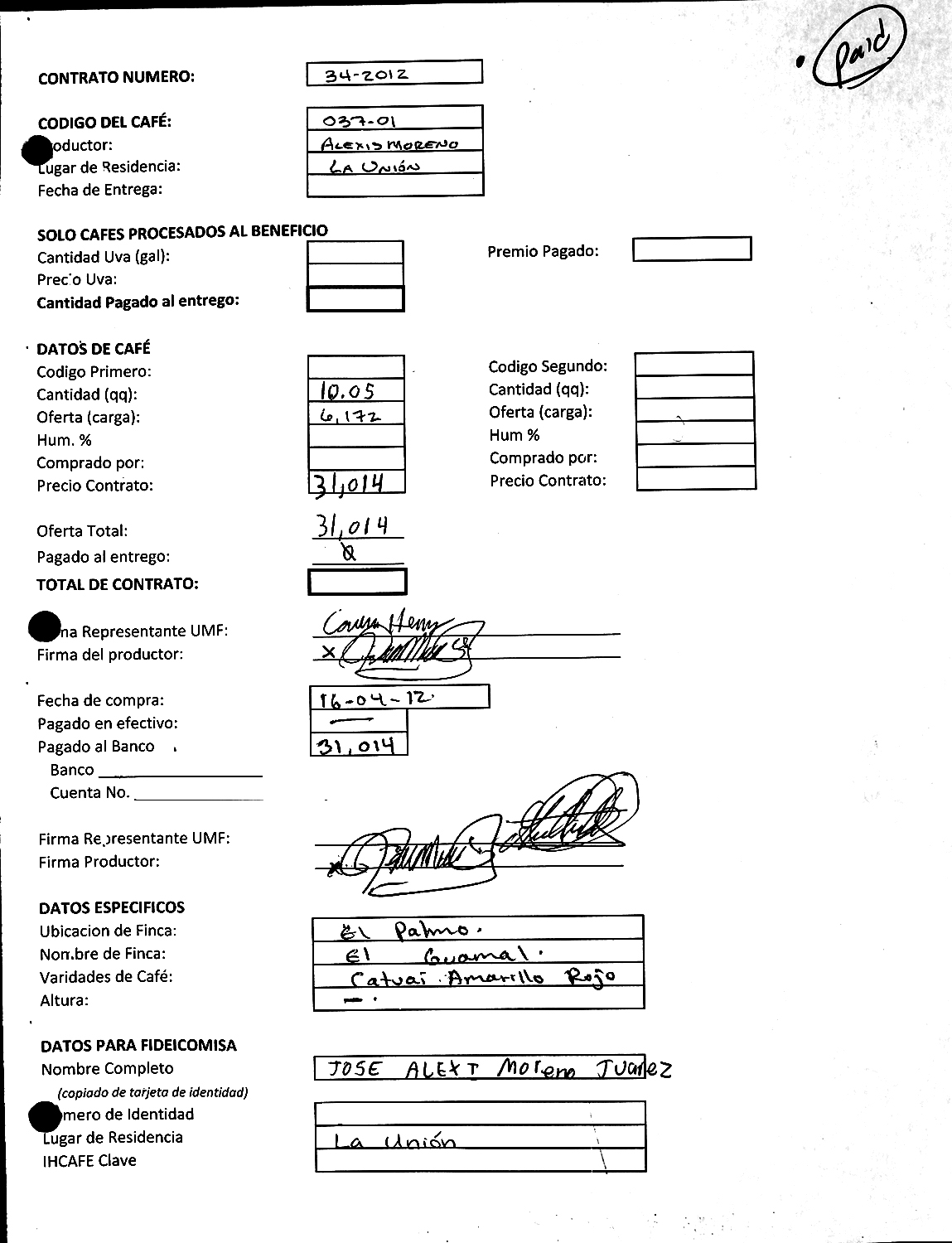
To illustrate how we purchase coffee, take a look at a sample contract (below) that we signed with Alexis Moreno. Don’t be discouraged if you aren’t fluent in Spanish. Here are the most important parts in the contract and a brief explanation of each:

  Código del Café (Coffee Code): A unique code assigned to each sample we receive.

  Cantidad (Amount): The amount of parchment coffee we purchased in qq, or quintales. (One quintal is 100 lb, so here, 10.05 qq corresponds to 1,005 lb.)

  Oferta (Offer): The rate we offer for each carga of coffee. (One carga is 200 lb, and the price is listed in the Honduran currency, Lempira. Here, 6,172 Lempira is equivalent to about $325 -- which means we’re offering $325 per 200 lb. of coffee.)

  Precio Contrato (Contract Price): The total price paid to the farmer -- the amount of coffee purchased multiplied by the rate offered. (Oddly, the standard practice is to list the amount of coffee in quintales, or multiples of 100 lb, and to make the offer per carga, or 200 lb. It’s a confusing system, and we didn’t invent it. The contract price takes this difference into account.)

  Firma (Signature): This contract was signed in UMF’s La Unión office by Alexis and Charlie Heins, UMF’s Financial Accounts Manager.


coffee contract


This contract is just one of the 44 contracts signed with 31 farmers. It’s an example of the only sort of transparency that we consider to be complete. We know exactly how much each farmer is being paid for their coffee because we are sitting at a table with them when the contract is signed; there’s nobody else in the middle.

Without further ado, here is UMF’s 2011–2012 Coffee Transparency Information:


There are a few parts of this document which may need more explanation. A mezcla is the Spanish word for “blend”—we refer to any coffee that combines more than one farmer’s harvests as a mezcla. There isn’t a price/lb green or FOB reported for any coffee that was part of a mezcla. During the parchment removal process, the amount of weight a coffee loses varies. The coffees are mixed before parchment removal, so there isn’t a way to accurately state the processing loss that occurs for each farmer’s coffee. We use the sum of all contracts and the total amount of green coffee to calculate the average amount that all farmers were paid. This prevents us from reporting green prices for individual farmers whose coffees are part of mezclas—there just isn’t an accurate way of doing so.

Another peculiarity is the lack of price/lb parchment for Mezcla #8. Coffee can only be exported from Honduras in 151 lb sacks. Typically, the amount of green coffee isn’t an exact multiple of 151. (For example, after processing, the amount of coffee we purchased from Rigoberto Paz came to 3,739 lb. We shipped it in 24 sacks for a total of 3,624 lb -- 115 lb short of the total he sold us.) Mezcla #8 is comprised of this leftover amount from all of the microlots. The green price is calculated using a weighted average of the amount of coffee from each farmer that went into Mezcla #8 and the green price of that coffee. It’s an estimate, but it’s as close as we can get to an exact price for the coffee.

You may notice that some farmers appear more than once on this document. This occurs when farmers sell us more than one lot of coffee. We cupped each lot separately, and if the flavor profiles were different, we kept them separated. Farmers like Bernardo Ponce appear both as a farmer who exported a microlot, and a farmer who contributed to a blend. He’s the same farmer, but he sold us two separate coffees with distinct flavor profiles.

This document represents several years of work both by UMF employees and the farmers that we work with. It’s the first time that we’ve published this information, and we ask that you understand that it’s still a work in progress. We’re already planning improvements for next year’s transparency report, and we encourage any feedback or suggestions.

That said, we firmly believe that this document accurately and transparently represents the prices that we purchased in the 2011–2012 harvest. “How much do you pay farmers for their coffee?” isn’t the easiest question—but now we’re proud to have a more complete answer.


There are several ideas that are presented in our Transparency Information that probably aren’t familiar to you if you don’t work in the coffee industry. We’ve tried to explain the basics above, but if you’d like more information—and especially if you’d like to compare our prices to those paid by other coffee buyers—please refer to the glossary below.

Price/lb parchment:
Parchment coffee is coffee that has been picked, processed, and dried, but has not yet had the shell (parchment) removed. All coffees that UMF purchases are “in parchment” since local farmers don’t have access to the equipment used to remove it.

This value is calculated as:


Price/lb green:
Green coffee refers to coffee that has been processed to remove the parchment. Removing the parchment from coffee decreases its weight, but the exact amount of this weight decrease can vary. Parchment coffee prices are rarely reported by other organizations, so we include the amount that farmers were paid per pound of green coffee that they sold us.

Since the amount of weight lost when processing parchment coffee into green coffee can vary, this number isn’t a completely accurate representation of the price we paid to farmers. For example, we paid both Antonio Castellanos and Pablo Paz (Lot #1) the same parchment price. Due to a higher processing loss for Antonio’s coffee, we were left with a smaller amount of green coffee in his lot. This means Antonio’s green price is $0.31/lb higher than for Pablo’s coffee—even though the parchment price is the same!

This value is calcuated as:


Price/lb FOB Puerto Cortés:
Of the three prices reported, this is the only one that includes money that was not paid to farmers (unless the farm is large enough that it has its own mill for export preparation and the farmer is able to directly export coffee). This price includes all transportation costs, export preparation costs, export licenses, and taxes. We include it as a reference since it’s commonly used by others. But it’s important not to confuse this price with any sort of price paid to farmers. It’s the least transparent of the prices—a high FOB does not necessarily indicate a high price paid to the farmer.

The last two words in this term, Puerto Cortés, refers to the seaport that all Honduras coffees are shipped from. You’ll encounter the term “Price/lb FOB Puerto Cortés” when comparing other Honduran coffees, but the last part of the term will be different when looking at coffees from other countries.

This value is calculated as:


Mezcla:
The Spanish word for blend. When we combine multiple farmer’s harvests into a single coffee to sell, we call that coffee a mezcla. All our mezclas are made up of coffee solely from La Unión. Since the coffee all comes from the same region, many other coffee buyers would refer to it as “single origin.” However, since our mezclas are comprised of coffee grown by multiple farmers from multiple fields, we insist on calling them blends.

Total Exp (lb): The total amount of green coffee exported by a farmer. Because the coffee used in mezclas were combined prior to the parchment removal, this number is not available for farmer’s coffee that was used for mezclas.