Written by Sally Wevers, who led a team from Calvary Church in Holland, Michigan, on a visit to La Unión from Feb. 11 to 18.
An eight person team recently returned from La Unión, Honduras.
Despite different ages, backgrounds, experiences, and viewpoints, the
group bonded extremely well. The Unión MicroFinanza staff did an
amazing job setting up the schedule, as we were able to spend time with
farmers, families, students at Abundant Life school, and individuals in
La Unión.
The trip was unique in that it took place
during coffee harvest, and we were able to receive and process Marlon
Carcamo's (Calvary's coffee provider) coffee cherries. We
picked coffee, unloaded 150-pound bags of fresh coffee cherries,
processed them through the beneficio, hand sorted, stirred beans in the
solar dryer, smelled, tested and tasted coffee.
We had times of reflection, devotions, and debriefing, sharing, and challenge. In order to share so many thoughts from the team, we are listing some
observations, impacts, and responses. We hope you enjoy reading about
what we have learned.
Observations:
- There is extreme poverty next to spectacular beauty, and the two extremes painfully clash.
- Calvary's coffee farmer, Marlon Carcamo, was thrilled and honored to
have North Americans pick in his field and have lunch in his home with
his family. But, the honor was ours.
- Our hearts hurt
for the difficult physical labor and efforts placed on our farmer
friends, so painfully affected by a leaf rust fungus that was no fault
of their own. The fungus destroyed major portions of the coffee fields
for many farmers. Knowing the families, having faces with names, brings
authentic sadness and concern to the team. Our prayers will now be more
intentional for them.
-"It is unfair that they work so
hard and their provision for food is wiped out. The unfairness makes me
mad! I don't think I will complain when I get my Saturday chore list
anymore," shared by the youngest member of our team.
- Physical provisions for families have been negatively affected, but
there is more. Education for many has been taken away. We spent limited
time in Nueva Paz -- this is where a team helped to build water collection
systems called pilas two years ago. Eight children could be named from
this one small community who had to quit their local school for lack
of $15 per student for the semester!
Impacts:
- We are committed to purchasing the Aldea Coffee at church, and
sharing our experience with others. The choices we make at home do
dramatically impact others.
- We are partnering with an
amazing organization in La Unión. The Unión Microfinanza (UMF) staff is
committed to change. One of the staff members shared this with us,
"Coffee is the thing we do to partner with and provide change. It could
have been tea, or something else. The driving passion we have is the
people, not the product."
- The UMF staff has the
wisdom and the education to teach and replicate supplies needed to
create smaller scale beneficios for area farmers. This training
continues to have ripple affects in the community. We are grateful for
Calvary's partnership with this organization.
- The
team was challenged to attain more responsible personal stewardship, to
consider what "living with less" might look like, to realize a growing
appreciation for UMF's tremendous commitment to La Unión, and we
experienced a greater appreciation for the education offered at Abundant
Life school. The spiritual maturity of high school students was a
powerful witness to us.
Most, if not all of us, have been asked,"Why go on a mission trip?" This is a summary of our answers. It is not about how much work that
could be accomplished, but rather it is about relationships renewed, and
others begun. It is not about what we could teach them, but what they
had to teach us. When we now know names with faces,
people matter. What they do and need matters, and responding to needs
brings Christ-centered joy. Mission trips motivate personally and communally. Step out of your comfort zone. Mission trips are addictive!

Showing posts with label Beneficio. Show all posts
Showing posts with label Beneficio. Show all posts
Monday, February 24, 2014

Friday, January 17, 2014
Photos: What’s new at the UMF beneficio
The first coffees of the 2014 harvest are in at the
beneficio! As we discussed in a previous post, we made some changes to
how we are running things at the beneficio this year. But we couldn’t do this
without making some changes to the beneficio itself.


First, and most importantly, we turned our four large
fermentation tanks into eight smaller tanks. This is important because it
allows each farmer to have two small tanks, meaning they can bring coffee more
continually:
Second, we are building another two solar dryers. One will
be a large solar dryer, totaling four, so that each farmer has access to their
own dryer. The other will be a smaller dryer that we designed in the
off-season. This dryer will be used mainly for experimentation, and will also serve
as a model to farmers who produce small amounts of coffee and cannot afford to
build a larger solar dryer:
Third, we have our custom-built coffee cherry size sorting
machine up and running. This machine will sort out under-ripe and over-ripe
cherries that would otherwise lower the quality of the coffee:
Fourth, we have installed a biodigester. This biodigester
will use anaerobic fermentation to treat coffee wastewater and coffee pulp,
ensuring that we are not contaminating the environment around us. Additionally,
it will produce methane gas that can be used to run our processing equipment.
More on this in another post.
We have also made several smaller changes including a newly
designed valve in our upper tanks that will facilitate coffee flow, lowering
our processing water usage, and check boxes in our wastewater tubing to prevent
blockages:
All of these changes will help UMF to better achieve our
goals of quality, training, and sustainability at the beneficio.
Monday, January 13, 2014
A new approach at the UMF beneficio
We’re firing up the depulping machine
at the UMF beneficio in La Unión, ready for the 2014 coffee harvest!
This year will look a little different at the beneficio – let us
tell you what’s new and what we hope to accomplish through the
changes we’ve made.
Each year, we
learn more about coffee processing and how to better achieve our
goals of quality, training, and environmental sustainability. The
2013 harvest season saw successes in all three of these areas, but we
want to improve on it by making changes for the 2014 harvest.
The biggest change we’ve made is that
only four different farmers will process their coffee at the UMF
beneficio this year. These farmers were pre-selected based on their
participation in previous years at the beneficio and in our microloan
program. The main idea for having only four farmers each year is to
ensure that we are able to provide the best training experience
possible, so that they will be able to replicate and continue
processing high quality coffee on their own in future years.
 |
| The fermentation tanks get tiling after being split in half. |
In addition, we (UMF) and the farmers
will be better able to manage how much coffee is coming to the
beneficio for processing, and when. Each of the four farmers will be
assigned an entire solar dryer and two fermentation tanks (we
modified our previous tanks to divide them in half and create eight
tanks in total). Farmers will be in charge of managing this
equipment, so they will know before they pick coffee if they have
room at the UMF beneficio to process, ferment, and dry it. Through
this experience, farmers will learn about managing the coffee
processing at their own beneficios in the future.
By working in-depth with four farmers
during this harvest, we will also be able to visit coffee farms on
the day of picking and offer on-site advice on picking quality
coffee. High quality picking is one of the areas that we have
identified as having the greatest impact on final quality, so this
will benefit the farmers (who will get a higher price for better
quality) as well as consumers, who will get even better coffee at the
end of the day.
Also, we’ll require farmers to spend
at least 20 hours at the UMF beneficio to learn about the different
processing stages that their coffee is going through, including
receiving, fermentation and drying. This in-depth training is
important to enable farmers to process their own coffee in the
future. Since we also want to make sure that other farmers have the
opportunity to receive this training in the future, we’re limiting
the number of years that a farmer can process at the UMF beneficio.
All of these changes will continue to
transform the beneficio into a stepping stone to farmers achieving
their own coffee processing capabilities. Within the next few years,
we are excited to see farmers graduate from the UMF beneficio and
implement high quality, environmentally sustainable beneficios of
their own. We will be posting updates throughout the harvest!
Wednesday, May 8, 2013
Harvest is over, but the learning continues
Coffee has been off the trees for
barely a month and already we are thinking about next harvest. May
and June is the time to prepare coffee fields, including pruning,
stumping, fertilizing, and targeting plant diseases such as coffee leaf rust. Due to the leaf rust plague, it is particularly critical
this year that coffee plants receive sufficient nutrition to fight
the fungus and produce new leaves and fruit.
UMF's field officers have been
receiving and giving trainings about coffee field recovery from leaf
rust. They identify plants that have died – these must be taken out
and new ones planted. If a plant is still living (even if it has no
leaves), a farmer can prune or stump the plant and hope for new
growth. If the plant has multiple trunks and some leaves remaining,
cutting down just one of the trunks allows the plant to continue
producing leaves and fruit at the same time as new growth occurs.
Martir, Pedro and Gilberto have been visiting coffee fields in La
Unión to analyze plants and recommend what
actions the farmer should take. The appropriate action is important,
since each of these repairs comes with a different expectation as to
when the tree will next bear fruit, and therefore become profitable
for the farmer.
 |
UMF field officers attend a Honduran
coffee institute training.
|
 |
Gilberto shows a farmer how to cut back
a
coffee plant that was affected by leaf rust.
|
Even after coffee harvest and
processing, UMF's beneficio continues to serve as a training center
for farmers and visitors. Recently, third-grade students from La
Unión's bilingual Abundant Life school spent a morning at the
beneficio. They learned about how we process and dry coffee, how we
collect and reuse water, and how we treat coffee wastewater and pulp
(using microorganisms and red worms) to turn it from a pollutant into
organic fertilizer. Below are photos from their visit:
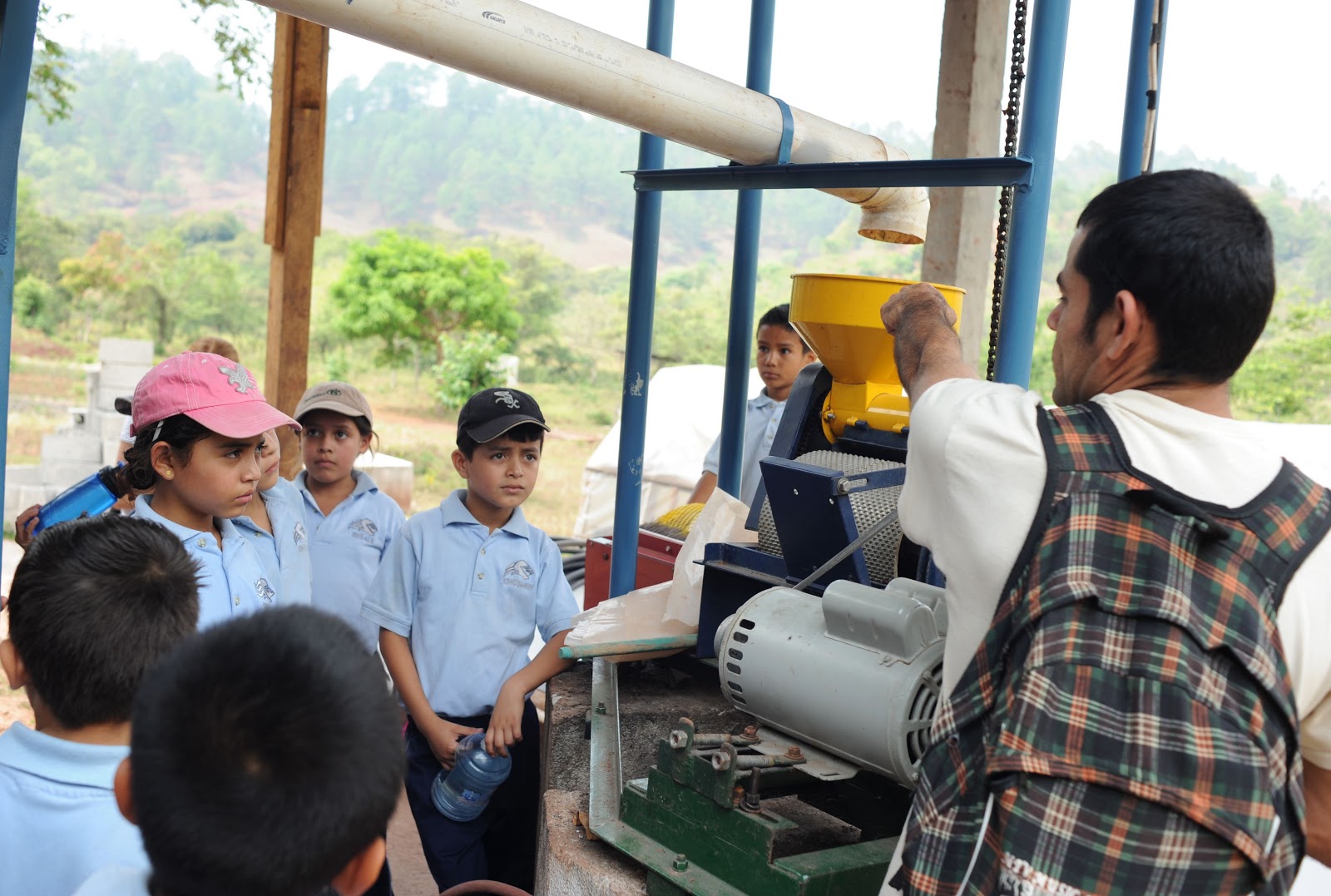 |
Martir shows the students how the
coffee de-pulping machine works.
|
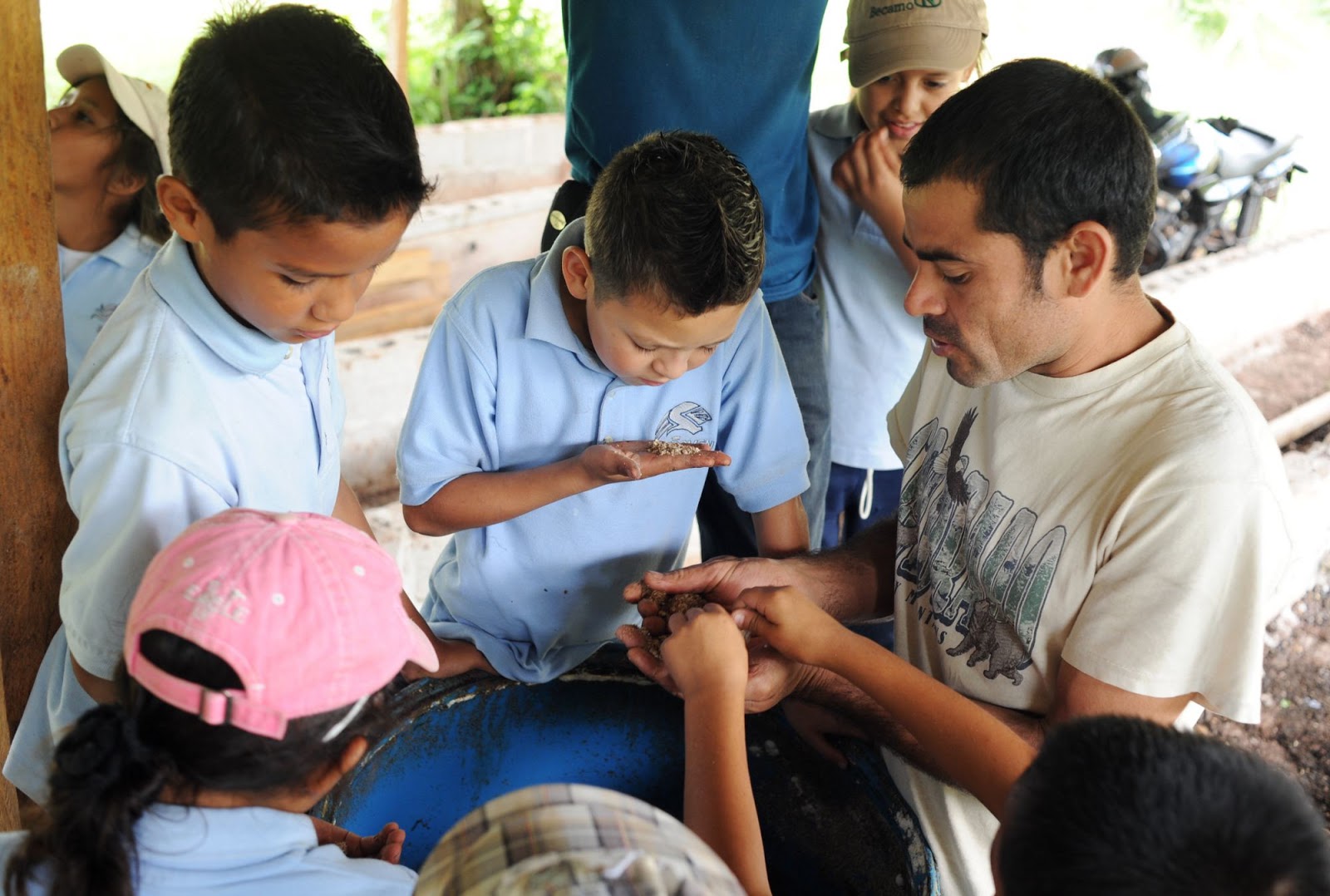 |
The students see how microorganisms
grow.
|
 |
Gilberto shows the students how red
worms break down coffee pulp into soil.
|
 |
The students learn how to treat coffee
wastewater to keep it from polluting waterways.
|
Friday, January 18, 2013
Beneficio processes first coffee of 2012-2013 harvest
A chilly rain fell on La Unión yesterday afternoon as we gathered under the newly-built beneficio roof, wearing sweaters and raincoats and jumping up and down, partly to stay warm and partly out of excitement. We looked up in anticipation at every truck that passed: we were waiting for Alfredo Ponce to arrive with this year's first coffee for processing at the beneficio.
Everything was in place, and daylight was beginning to slip away. Then, at 5:30, a truck carrying coffee came up the new road to the beneficio. Alfredo jumped out of the truck and greeted us with a smile. We unloaded the bags and found them full of gorgeous, ripe coffee. It was time for the first run of our new sorting equipment, system for moving coffee, and fermentation tanks.
An hour an a half later, we finished processing. Alfredo, who processed coffee at our beneficio last year as well, stayed to see the new sorting mechanisms and other changes we'd made for this year. Despite being tired and wet after processing, we were very happy that the new density and size-sorting mechanisms worked beautifully and that coffee flowed through the system much better than last year. We still have small changes to make, but we are excited to have started processing coffee and we are looking forward to the next few months!
Here are a few pictures from the afternoon:
Alfredo Ponce (in orange) helps unload coffee at the beneficio.

The coffee, mostly of the variety IHCAFE 90, waits to move to the de-pulping machine after the floating cherries were skimmed off and the water drained.

We removed floating coffee and sent it to another tank to be collected separately.

Alfredo brought us 25 gallons (about 750 lbs.) of coffee cherries from his farm, which is at an altitude of about 1,475 meters.

Alfredo watches his coffee go through the de-pulping and size-sorting machine.

A locally-made sorting machine separates de-pulped coffee from damaged coffee.

Tuesday, January 15, 2013
Beneficio updates nearly complete
We are very excited about the improvements and additions we've made to our coffee beneficio this year, and soon we will be receiving coffee from this harvest for processing. Below are photos of the construction over the last few weeks.


Martir spreads cement on the outer
walls of the biosand filter for the upper water tank. This will provide
filtered water for use in fermenting, washing and sorting coffee.

Gilberto helps sort stones of
various sizes to be used in the biosand filter, while the rest of the stones
make up the road leading to the beneficio for trucks carrying coffee.

Our coffee processing center
receives a roof of teja – clay tiles – to protect the tanks, coffee, and those
who are working, from rain and direct sun.


The fermentation tanks have gotten a
beautiful – and practical – makeover with a new drainage system and tiles
lining the tanks. The drainage system will facilitate washing of coffee, and the tiles are designed to improve coffee quality by
being easy to clean and resistant to wear.


The receiving tanks have been
redesigned to use less water during sorting and moving of coffee. These tanks,
as well as the correteo, have been painted to protect them from sun damage and
help keep them clean.

We have three solar dryers up, and one
more on the way, to provide more space for drying coffee in a protected
environment.

The vermiculture has received a
drainage system to allow excess water to drain from the area where coffee pulp
will be turned into organic fertilizer. The worms and the microorganisms are
ready for coffee pulp!

Our new sorting equipment was custom built by a local coffee equipment maker. It will separate out improperly de-pulped coffee from the rest. One more piece of sorting equipment is still being built and we will add this to the process soon.


Friday, December 7, 2012
Construction continues at beneficio
Our beneficio additions are progressing! We are very excited that the coffee processing center will
soon have a roof over it, and the vermiculture is getting its drainage system
to remove excess water while coffee pulp is decomposing into organic
fertilizer.
Below, you can see the progress of
the construction.
Martir constructs the walls of the
biosand filter next to the upper water tank:

The roof is going up over the
processing center. Teja (clay tiles) will provide the cover over the wood:


One of two new solar dryers has been
constructed:

The water treatment trenches have
been cleaned out and are ready to receive processing wastewater:

A
road is being built to better enable vehicles carrying coffee to reach the
beneficio:

The aisles of the vermiculture are
getting a drainage system to prevent flooding:

Thursday, November 8, 2012
Beneficio improvements begin ahead of coffee harvest

But these changes will not only improve coffee processed here; they will also serve as examples for farmers who process their own coffee, so they may see how to make improvements on their facilities. As with everything that we do at the beneficio, all of the changes are designed to be easily replicable by farmers in the area. We also want to constantly reduce the environmental impact of processing coffee, and many of these changes will help us reduce our environmental impact.
This is an introduction to the improvements we will be
making this year, but watch this blog throughout the coming months as we
explain each in more detail and provide photos of the construction.
Here’s what
we’ll be working on:
·
Receiving tank
improvements – We will be moving receiving tanks and redesigning them to make
it possible to receive, sort, and move coffee with much less water usage.
·
Mechanisms to sort
green and partially pulped cherries – These sorters will help ensure that any
coffee that is damaged or not fully developed will be separated from good
coffee.
·
A biosand water
filter for water to be used in processing – This filter will ensure that all
water used for fermenting, washing, and sorting coffee will be of the highest
quality.
·
Construction of two
additional solar dryers – These solar dryers will help increase the capacity of
processing, since drying was our largest bottleneck last year.
 |
| We're building two more solar dryers so we can process more coffee at a given time. |
·
A roof over the
beneficio – It’s no fun processing coffee without a roof over your head when it
is 50 degrees and raining. The roof will also help keep direct sunlight or rain
from falling on fermenting coffee, thereby increasing quality.
·
Tiles in the
fermentation tanks – These tiles will make it easier to keep fermentation tanks
cleaner, which will increase quality.
·
New drainage tubes
in the fermentation tanks – These drainage tubes will facilitate easier and
more complete washing of coffees after the fermentation process.
·
Improvements on the
road leading to the beneficio – We want to ensure that any car/horse/person can
get into the beneficio, and the road improvements will facilitate this access.
·
An overflow valve
for the water tank to prevent flooding – Large amounts of rain previously
caused our water storage tank to overflow. This valve will send excess water
into our water treatment channels, where it can be recycled for future use.
·
A drainage system in
the vermiculture – This will allow us to catch runoff from coffee pulp, which
can be recycled as organic pesticide and fertilizer.
·
Paint for the
correteo – This will help us keep the correteo sorting mechanism cleaner, and
will protect the cement from sun damage.
·
Water treatment and
water system improvements – These improvements will help us to effectively
treat coffee processing water to avoid environmental contamination.
We are very
excited to start receiving this year’s harvest at the beneficio, and we hope
that through these coming blog posts, you will learn more about coffee
production, the environment, and coffee farmers in Honduras.
Wednesday, October 31, 2012
Farmers use micro-organisms to recycle coffee pulp
 |
| Nelson Gamero talks to coffee farmers about micro-organisms. |
UMF has been testing different ways to
treat coffee pulp and turn it into organic fertilizer. Treating coffee pulp –
the fruit that encases the bean and that is removed during processing – is an
important way to reduce environmental impact in processing coffee. Untreated,
this pulp is extremely contaminating to the environment. One kilogram (2.2
pounds) of untreated coffee pulp contains contaminants equal to a day’s worth
of human excrement. The water used in processing must also be treated: 1 liter
of untreated processing water contains contaminants equal to 15 liters of
urine. If all of the coffee pulp in Honduras were left untreated, it would be
as if a 2.6-million person city had no form of waste treatment.
Coffee pulp and processing water can
be recycled as fertilizer, but they must be treated first in order to keep from
acidifying the soil, producing odor, and contaminating groundwater. Here are
where micro-organisms come in. There are different ways to break down coffee
pulp into fertilizer, which we outlined in a previous blog post. The
least-expensive option, while it takes some work and time, can be done with
local materials: home-made organic product composed of locally-grown
micro-organisms.
 |
| Farmers prepare micro-organisms to treat coffee pulp. |
UMF will work with farmers in its microloan and training program
to build on this training session during the coming harvest. We will be
distributing micro-organisms, teaching how to properly use them to treat coffee
pulp and wastewater, and working with farmers to implement this technology to
decrease environmental impact of coffee processing in La Unión.
Tuesday, January 3, 2012
Beneficio, Systems Explanation: Solar Dryers
Once coffee is fermented and washed, it must be dried from 46% humidity down to 11%, at which point it is stable to be stored for long period of time. If this drying doesn’t begin within hours of washing, the high humidity levels can cause the coffee to develop off flavors and ruin it. At the beneficio, we will be using solar dryers for this drying process.
When people hear the words “solar dryers” they often think
of solar panels, moving parts, or engines; however, solar dryers use the sun’s
energy in a much more direct way. Solar dryers look much like small
greenhouses, with shelves inside of them to dry coffee. They provide protection
from wind and rain, while concentrating the sun’s energy into a force to dry
the coffee.
 |
| Solar dryers concentrate the sun's energy to dry coffee |
Other than solar dryers, there are two main forms of coffee
dryers. The highest volume form is mechanical dryers, which load approximately
22,000 lb of coffee into an elevator system and heat coffee by burning wood or
coffee shells. The other is patio drying, in which coffee is spread into thin
layers on a cement patio.
There are two reasons that we are using solar dryers instead
of these other two options: quality and environmental sustainability.
We are configuring our solar dryers to dry coffee in 7-10
days, as opposed to the 4-6 days of patios or the 24 hours of mechanical
dryers. High temperatures created by contact with hot cement or passing near
the flames of mechanical dryers are damaging to the structure of the coffee
bean, lowering the quality. Additionally, coffee is never placed on the ground
using our solar dryers. Patios, which must be used for a short amount of time
even when mechanically drying coffee, are frequent hosts to trucks, children,
dogs, chickens, pigs, and anything else that may be in the area. Finally, there
is no way to bring coffee that is on a patio under shelter quickly in the case
of a rain storm, and rewetting coffee even slightly can completely ruin the
quality. Mechanical dryers cause great physical stress on the coffee—not only
because of high temperatures but also because of the large impacts that happen
as the coffee falls almost 40 feet from the top of the dryer to the bottom.
 |
| Patio drying coffee takes large amounts of space and dries coffee on the ground, where it is often walked on and driven over |
Our second reason for using solar dryers is that they are an
important part of making an environmentally sustainable beneficio. Drying
patios require extremely large amounts of space and, therefore, a very large
amount of cement. Due to the large area necessary, drying patios also represent
a reduction in arable land. By installing solar dryers, we are keeping the land
surrounding the beneficio available to grow off-harvest plants (from new coffee
seedlings to nitrogen fixing beans to hardwood trees to plant in farms).
 |
| Mechanical dryers have a tall column (blue in picture) with large furnaces to heat coffee (silver in picture) |
Mechanical dryers, on the other hand take up a relatively
small amount of space but require large amounts of energy input. First, they
require electrical energy to consistently move the 22,000 lb of coffee inside them.
Second, they require large fires to create the temperatures necessary to dry
coffee. This requires the use of wood, causing deforestation; or coffee shells,
which could otherwise be used to make organic fertilizers; and the burning of
either of these produces carbon dioxide which is then released into the
atmosphere. Once built, solar dryers require no input other than one person to
move coffees every 30 minutes.
We installed our first of four solar dryers in a joint
training session with IHCAFE, UMF clients, and members of the COCAQUIL Coffee
Cooperative. The other three will be installed in coming weeks as we prepare to
ramp up processing at the beneficio.
So there you have it—solar dryers.
Thursday, December 8, 2011
Beneficio, Update 6: Two floors, and more!
There has been great progress at the beneficio in the past week!

 Which brings us to the next update: the floater-separator and de-stoning machine have been installed. They were built into the floor, but received additional finishing work to ensure the proper dimensions. Additionally, each of these has a grate in the bottom which will allow water to drain out when not in use. This water will drain into a collection bin, then flow to join up with other water used in the beneficio. This water will then go into the beneficio’s water purification system (more soon!).
 The receiving tank is almost complete. An incline was built in to help move coffee toward the exit. All that is missing is a gate at the exit and a faucet.
 The fermentation tanks are also almost finished, with inclines built in to help facilitate movement of water and coffee. These tanks have a grate for the exit of water and coffee mucilage after fermenting and washing, and a separate exit for coffee. Coffee will go from fermentation tanks into a correteo (SPOILER ALERT: A new piece of equipment to be installed. More soon!).
 The storage room finally resembles a room. The floor has been laid, and space has been made where the door and window will go.
 There isn’t a ton of space inside, but plenty to store some processing documentation, a little coffee waiting to be moved into storage, or UMF employees pulling all-nighters watching fermenting coffee.
 Oh yeah, and the view out the window isn’t too bad, either!
 The vermiculture is almost completed. All that is left is the second level of cement blocks in the channels where coffee pulp will be placed, and a few more sheets of roofing.
Up next: Installation of tubing for the water system, finishing up the gate for the receiving tank, laying the last bricks and roofing pieces on the vermiculture, and hanging the door and window on the storage room. Stay tuned for more!
Subscribe to:
Posts (Atom)