Showing posts with label projects. Show all posts

Tuesday, July 29, 2014

Community Partnership Coordinator: Pedro Hernández

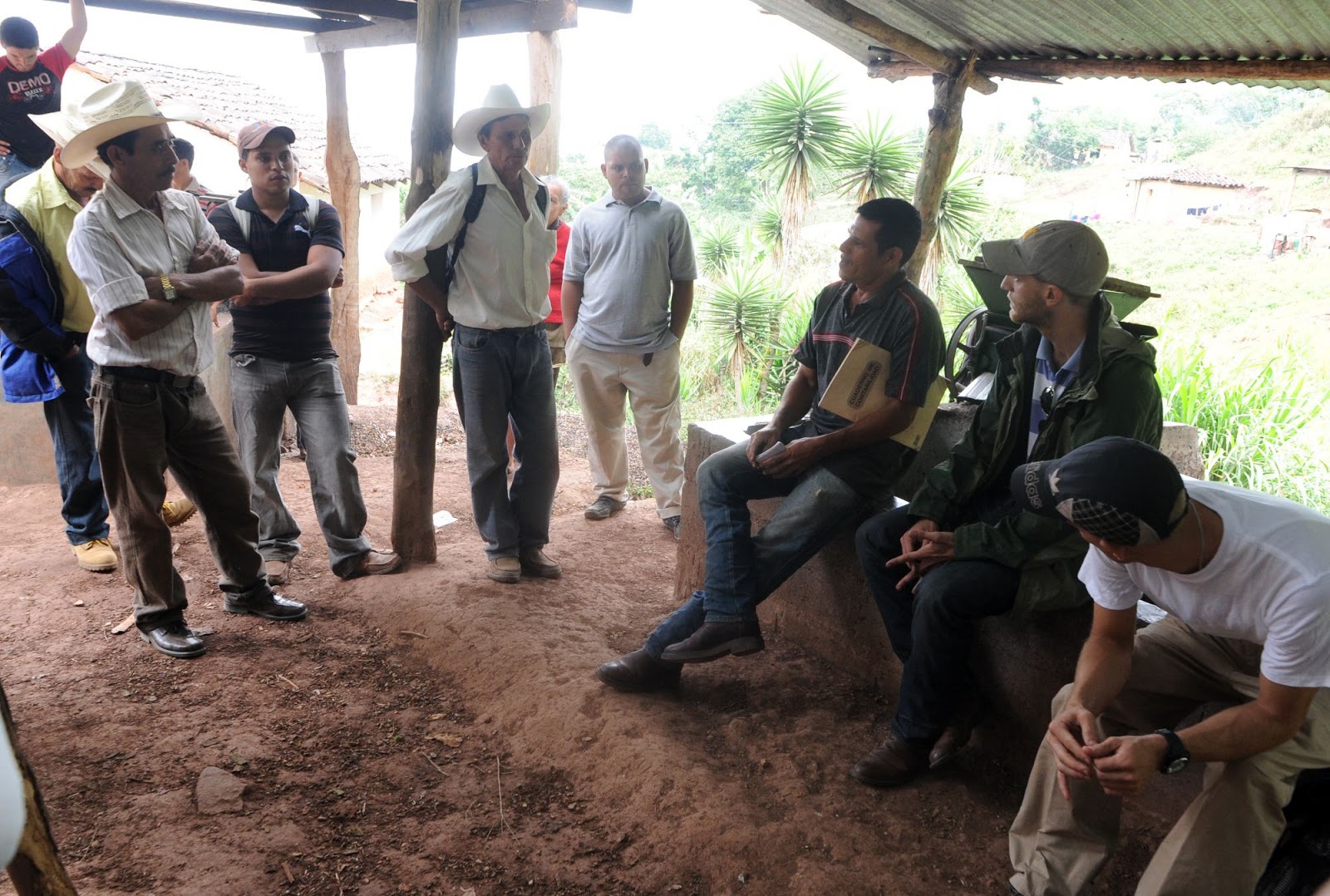
Pedro, center, joins members of the village of San Agustín and Life Church
of Colorado at the start of a community partnership project.
We’re wrapping up a meeting in the UMF office; Pedro has just given an update on a development project in one of the villages. He’d met with the community leaders and coordinated with the engineer to begin the next phase of the project. The village’s project committee had a few questions for Pedro as well, which we will discuss with the project partner in the U.S. Through Pedro, and other members of the UMF staff, the communities in La Unión and the U.S. stay connected on community projects and also on a personal level, even though they are not able to be physically in the same place.

Pedro, right, takes notes in
La Cuesta in preparation for
a community project.
Community development is by no means straight forward; promoting sustainability and positive growth requires planning, adaptability, and above all collaboration. As such, Uniόn MicroFinanza intentionally involves community members and community partners in every step of development projects. To coordinate this collaboration and communication is UMF employee José Pedro Hernández Tejada. Because of his rapport within the communities and experience with social promotion, Pedro, a 28-year-old La Uniόn native, has been irreplaceable since he was hired two years ago. The people in the communities know Pedro well, and the respect they hold for each other helps them reach agreements.

Without Pedro, community partnership projects would not run nearly as smooth. Coming from a background of small-business (his family owns a small store in La Unión), Pedro is extremely organized and attentive to detail. He plans and helps direct meetings among community leaders to move forward on community projects. He travels to the communities to see how projects are advancing and take note of any of the community’s concerns or ideas. He is truly the link that connects communities in the U.S. and in La Unión.


Pedro helps coordinate a water access
project in San Agustín.
As much as Uniόn MicroFinanza relies on the work and relationships established by Pedro, he also relies on UMF for his well-being and future plans. Recently engaged to be married, Pedro is looking forward to providing for his new family through his work with UMF. Your generous donations to the organization support important community development projects, and they also support the people who make these projects happen. Find out more on our website about becoming a donor. Thank you for your partnership with Unión MicroFinanza and the people of Honduras!

Tuesday, June 17, 2014

Summer in La Unión, sharing knowledge and experiences


If La Unión had a tourism industry, its high season would be June. Many visitors, new and returning, come to town as their school year ends, but they aren’t coming as tourists. Sure, the tropical green mountains and open views of the valleys are impossible to miss on the drive into town. But most of these visitors are coming to meet new friends (and possibly visit old ones), and continue building partnerships between their respective communities. And for three interns, these relationships will be formed over their 10 weeks in Honduras.

As with previous summers, Unión MicroFinanza hosts interns for the summer months to assist with and learn about community partnership projects (watch the blog to read about new projects!) and the microloan, training and coffee programs. These interns also provide the organization with valuable research on topics varying from coffee leaf rust to markets and savings.

Besides this, summer interns live in the town and spend time with the people who live here. They will take these experiences and new perspectives with them as they return to their universities and friends in the States. This year, four interns are joining UMF, with one arriving later in the summer. Aidan Baldwin, Andreas Vailakis, and Marcus Warner have different areas of study and interests, which allows them to work on a variety of projects with the organization.

AidanAidan comes from the University of Notre Dame, where he is studying finance and entrepreneurship. Along with the other interns, he is helping organize and carry out distribution of June microloans. Aidan has already noted that some of the needs and resources in these communities differ from those he has visited in other developing countries. He’ll be hearing more about market access for small farmers in La Unión, and more about Aldea Coffee, which sells La Unión coffee in the U.S. Besides this, Aidan hopes to improve his Spanish, aided by the Honduran UMF staff.


andreasAndreas is studying for his master’s degree in social enterprise from American University, concentrating on international development in Latin America and monitoring and evaluation. In addition to working on a monitoring and evaluation plan for UMF programs, Andreas is interested in learning more about the savings strategies of households in La Unión, including investing in and selling non-perishable goods. During his internship, Andreas is staying with a farmer in UMF’s coffee training program. In living with them, he has noticed that women in La Unión have just as much work to do as the men: “Although Martha, the mother, is nearly the same age as me, she feels like my Honduran mom. I’m impressed by how hard she works and how much she does in the day. She is typically the first one to wake up in the family and the last one to bed, and I almost never see her taking a break.”


marcus
Marcus Warner studies civil and environmental engineering at the University of Illinois in Urbana-Champaign, focusing on hydrology and energy-water-environment sustainability. His knowledge will be valuable for the two water-focused community partnership projects that UMF is currently involved with. Marcus is excited to learn from UMF employees Gilberto, Martir, and Pedro, who creatively approach engineering challenges based on experience rather than formal training. “Perhaps the most valuable thing that this internship will leave me with is motivation. In all of my classes before this summer, the problems that needed solving seemed abstract, even if they were based on a real-world engineering project. However, working with villages through similar problems this summer has given me a powerful frame of reference for future schoolwork.”

Friday, January 17, 2014

Photos: What’s new at the UMF beneficio

The first coffees of the 2014 harvest are in at the beneficio! As we discussed in a previous post, we made some changes to how we are running things at the beneficio this year. But we couldn’t do this without making some changes to the beneficio itself.

First, and most importantly, we turned our four large fermentation tanks into eight smaller tanks. This is important because it allows each farmer to have two small tanks, meaning they can bring coffee more continually:


Second, we are building another two solar dryers. One will be a large solar dryer, totaling four, so that each farmer has access to their own dryer. The other will be a smaller dryer that we designed in the off-season. This dryer will be used mainly for experimentation, and will also serve as a model to farmers who produce small amounts of coffee and cannot afford to build a larger solar dryer:


Third, we have our custom-built coffee cherry size sorting machine up and running. This machine will sort out under-ripe and over-ripe cherries that would otherwise lower the quality of the coffee:


Fourth, we have installed a biodigester. This biodigester will use anaerobic fermentation to treat coffee wastewater and coffee pulp, ensuring that we are not contaminating the environment around us. Additionally, it will produce methane gas that can be used to run our processing equipment. More on this in another post.


We have also made several smaller changes including a newly designed valve in our upper tanks that will facilitate coffee flow, lowering our processing water usage, and check boxes in our wastewater tubing to prevent blockages:


All of these changes will help UMF to better achieve our goals of quality, training, and sustainability at the beneficio.

Monday, December 16, 2013

In coffee leaf rust experiment, a surprise discovery


We're just over three months into UMF’s experiment comparing chemical and organic treatments for coffee leaf rust. The experiment is going well, but full details on how the treatments are working will come later, as we are still analyzing the most recent sampling. Apart from the treatment results, we have observed something interesting and unexpected. We first saw it a little over a month ago, and we confirmed it with formal sampling this past week: branches that don’t have any leaves start to die, but branches with even one leaf remaining, stay alive.

In our analysis, we found that 91% of branches that have no leaves showed signs of dying (dieback): blackened ends and softening of the branch. However, only 16% of branches with a single leaf showed signs of dieback. And 0% of branches that had two or more leaves showed signs of dieback.

These results are interesting for two reasons. First, it suggests that keeping a single leaf on a branch will prevent most long-term damage that will affect future harvests. Having two leaves on a branch ensures that no long-term damage will occur to the branch.


For farmers dealing with leaf rust, this observation has important potential implications. Throughout the course of the harvest year, a coffee plant grows new leaves, although this growth is concentrated during the rainy season. Farmers may be able to prevent long-term damage to a plant simply by using proper preventative measures to protect new leaves, even when older leaves of a plant are highly infected by leaf rust.

Second, our observation suggests that the long-term effects of leaf rust are branch-based, rather than plant-based. If a branch losing all of its leaves had a negative effect on the rest of the plant, we would expect to see a larger number of branches that show dieback but still have leaves. This means that proper treatment of leaf rust on one branch will not necessarily prevent long-term damage to other branches on that same tree. But, conversely, damage to one branch will not necessarily cause damage to another branch.

Furthermore, it appears that the effects of leaf rust are not transferred between primary branches and the secondary branches that grow off of them. Even though they are part of the same branch, we are seeing that secondary branches can lose all of their leaves and start to die while the primary branch continues to be healthy, and vice versa.


These numbers are not yet conclusive, and further experiments will need to be run in the future to be certain that leaf loss is causing, not just associated, with the dying of branches. There is still much to be done in terms of understanding how to take these new results and convert them into practical leaf rust prevention advice to farmers. However, they are certainly suggestive that the last few leaves are vital to the survival of coffee plants. We will continue to keep you informed as the experiment progresses.

Monday, August 12, 2013

Communities of San Agustín and Fort Collins reunite

By Kayli Horne

For three years, Flood the Nations and Life Church in Fort Collins, CO, have been visiting La Unión and surrounding villages. Last year, a team worked with the village of San Agustín to install water filters. This July, a group returned to spend time in the village again, catching up with people they'd met, seeing how the filters were improving families' health, and meeting with village leaders to discuss possible partnership projects for the future.

As a summer intern with Unión MicroFinanza, I got to witness the community partnership-based model of development as the group visited different families in San Agustín, and see how the filters have impacted their lives. Unanimously, the people spoke of improved health for themselves and their children due to the filter systems. The Fort Collins group got to see how their fundraising and trip last year have been effective. This is a crucial aspect of this development model. Monitoring the success of past projects keeps people accountable, prevents wasted resources, and informs future initiatives.

UMF's Patrick Hughes translates as leaders
from San Agustín present project proposals.
The highlight of my time with the group was the community meeting in San Agustín. Community leaders, husbands and wives, and children, along with the UMF team and the Fort Collins group, congregated in the village's meeting place: the church. Here is where I saw the difference in this kind of development strategy, which involves the close participation of community members. As North Americans, we did not start the meeting with our plans for the community. Rather, we offered it up to the community to present their ideas. The main presenter was an amiable middle-aged man, who professed learning to read and write in his adult years on his own. My respect for him instantly swelled. He outlined six main proposals that had been designed with general community needs in mind.

Watching this man speak and then the community members vote on a proposal, I was reminded of my readings about development theory. In his book Development as Freedom, Amartya Sen argues that freedom ought to be viewed as the means and ends of development. When one of the community leaders was presenting, I began to see how this theory works in practice. Through involving him in the planning process, he is a direct agent in the process of development. His meaningful work planning proposals is not only helping accomplish the goal of our work here, but also is the goal itself.

It is no wonder to me that people scoff when one aims at grand poverty alleviation plans or having a desire to “save the world”. These goals are too general, and it is easy to be overwhelmed by the needs. The beauty of one community partnering with another is that communities with excess material goods can narrow their focus in the developing world, while at the same time building meaningful relationships.

As one member of the Fort Collins group put it, the people of San Agustín may be poor economically, but we are poor in spirit. Through visiting year after year, these partnering communities create a relationship based on mutual respect. Rather than a give-receive based model, these partnerships foster collaboration and working together, as well as meaningful relationships for members of both communities.

Friday, May 17, 2013

Water for every household

We stop climbing and catch our breath under some trees, sheltered from the blazing May sun. I turn to look down the dusty, steep path. A panorama of rolling blue-green mountains opens up below the coffee fields we’d just come through. Tiny buildings, far down in the valley, mark the town of La Unión, and further up the mountain, the village of La Cuesta, from where we’d started our hike.

Unión MicroFinanza staff, a water engineer, and a group from Lakeshore Fellowship Church in Spring Lake, Michigan, are following representatives from La Cuesta’s water committee to see the village’s water source: a stream that begins in a small forest, high on the mountain. We are going to test the quality and amount of water flowing from the source. Our shared hope is that this source will be able to continually feed into a water tank and provide consistent, running water to the homes in La Cuesta.

Clean water is an essential resource: it affects health, education and economic stability. When a person becomes sick with a water-borne illness, they must spend money on medicine that could otherwise have gone toward food or school supplies. A person who is ill loses work opportunities and cannot earn money to pay for medicine, further impacting their economic situation. A child who falls ill must be cared for, resulting in the same lost opportunities.

Members of Lakeshore Fellowship Church learn how
women in La Cuesta wash clothes.
Currently, more than 40 homes in the village get their water from narrow, rubber hoses, meant to hold electrical wires rather than water. Houses often share access to a single hose, further limiting resource availability. Hoses often break or disconnect from the source (the mountain stream), and the people we surveyed said they typically only have water for three days in a week.  Because there is no way to regulate the flow of water coming through these hoses, some houses receive all the water, and it is used up before it reaches the others.

This inconsistent, insufficient supply of water is what each family must use to bathe, wash dishes and clothes, flush waste, and water gardens. Think about all the ways you use water every day. Think about how your daily life would change if you didn’t have a dishwasher, wash machine, or flushing toilet. Then imagine that for four days out of a week, you had to use water that you’d collected ahead of time in plastic pails.

In the town of La Unión, in the valley below La Cuesta, large water tanks regulate water during the dry season. Water is turned off during the day to save it for use in the evening or following day. When water is off, families can use a reserve of water they collected in a pila – a large cement basin that serves as a washing station and place to store water. However, few families in La Cuesta have pilas. So, they must collect water in plastic bins or hike up a mountain to get water when it doesn’t come through the hose system.

La Cuesta's water committee meets with leaders in
San Carlos to learn about their water system.
La Cuesta’s water committee is made up of men and women from the community who will be involved in this improvement project on all levels. They are forming a plan for the community to provide the labor needed to build the tank and piping system, and they will write rules for community meetings and household use of the water. During Lakeshore’s time in La Unión, we joined the committee on an informational visit to San Carlos, where a water system was inaugurated last year. San Carlos community leaders explained their water regulations and gave advice to the newly-formed La Cuesta committee. As they learned about San Carlos’s water project, the members of La Cuesta radiated enthusiasm for how their own project would become a reality.

We’ve only just begun this project, and there is much work to be done by all the partners involved. But these first steps have sparked excitement on all sides to continue forward and establish access to this essential resource for each family in La Cuesta.