Okay, so we’ve been showing updates and talking about the beneficio for more than a month now, but how does it all fit together? That’s the purpose of this systems explanation—to show how everything comes together. First, here is a computer model that was used for its design, which shows what everything will look like when its done:
There are 11 major parts to the beneficio, though not all are physically connected. Each system has a picture at its current stage of development (but please excuse any mess, it is still under construction!)

1. Receiving: Trucks will drive up into the flat area behind the beneficio and unload coffee into the receiving tank. We will measure the volume of cherry coffee coming in, and also take samples to check for over-ripe, under-ripe, and damaged coffee. We will be giving bonuses of L.5/gallon (about $0.06/lb) for coffees meeting the high quality standards.
Coffee will flow out of the receiving tank and into the …

2. Floater-Separator: This mechanism will separate out damaged beans (called ‘vanos’ in Spanish). Bad coffee flowing into the floater-separator will float on the top of water in this basin and get siphoned off into a separate holding tank.
Good coffee, on the other hand, will fall to the bottom of this basin, then get suctioned through a tube to the…

3. Destoning Machine: This machine also functions using relative densities. Stones, sticks, and other objects that may be mixed in with coffee will be pulled downward while coffee floats with the water current.
This step is vital to be sure that no foreign, potentially damaging, objects enter the…

4. Depulping Machine: Fruit is separated from bean in the depulping machine (note: currently under construction, only the forms for the depulping machine mount, not the machine itself, is pictured).
Fruit is gathered to be transported to the
vermiculture and coffee beans are transported to the…

5. Fermentation tanks: Fermentation is one of the most important steps to producing a specialty quality coffee. All coffee will be fermented under water to ensure even fermentation, and will be washed after 12-16 hours to remove the sticky mucilage (which would otherwise ruin the coffee) which is left after depulping.
Washing water and coffee are then passed separately in the…

6. Water Separator: The fermentation tanks each have small exits at the bottom, so that the water-mucilage mixture can be separated from coffee and disposed of. Coffee is left about 95% mucilage free.
To remove the rest of the mucilage, coffee is moved to the…

7. Soaking Tanks (not yet installed, picture from another beneficio): Coffee sits in soaking tanks for 24 hours, with water being changed every 6 hours. This ensures that no mucilage is left in the coffee.
Once soaked, the coffee is moved to the…

8. Solar Dryers (not yet installed, picture from another beneficio): Coffee leaves the soaking tanks with a water content of 46% and must be dried to 12% in solar dryers. Coffee will be in solar dryers for 7-10 days, being moved every 30 minutes throughout that time.
9. Water system (not yet installed): Coffee is transported through this system using water. All water is collected from the vermiculture roof, pumped to a pressurizing tank 100 ft above the beneficio, then released for transport, use in the floater-separator, fermentation, and washing processes.
10. Roof: This year, we will have a tarp roof for the beneficio. Between harvests, we plan to complete the roof.

11. Storage Room: We will be taking advantage of every square inch of the beneficio area. Rather than filling in the space below the beneficio floor, we put in an extra wall and will be using this area for storage of machinery, coffee, and occasionally sleeping when processing goes through the night.
There it is! Keep checking back for more updates on the progress, as we plan to finish construction within the next two weeks.


 Which brings us to the next update: the floater-separator and de-stoning machine have been installed. They were built into the floor, but received additional finishing work to ensure the proper dimensions. Additionally, each of these has a grate in the bottom which will allow water to drain out when not in use. This water will drain into a collection bin, then flow to join up with other water used in the beneficio. This water will then go into the beneficio’s water purification system (more soon!).
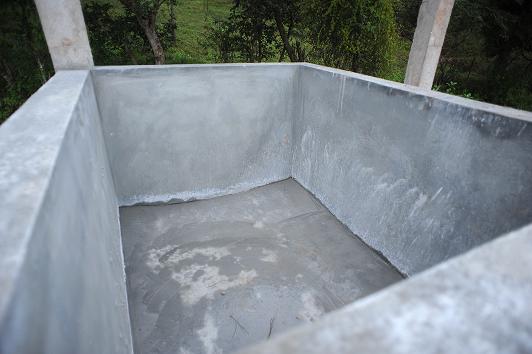
 The receiving tank is almost complete. An incline was built in to help move coffee toward the exit. All that is missing is a gate at the exit and a faucet.
 The fermentation tanks are also almost finished, with inclines built in to help facilitate movement of water and coffee. These tanks have a grate for the exit of water and coffee mucilage after fermenting and washing, and a separate exit for coffee. Coffee will go from fermentation tanks into a correteo (SPOILER ALERT: A new piece of equipment to be installed. More soon!).
 The storage room finally resembles a room. The floor has been laid, and space has been made where the door and window will go.
 There isn’t a ton of space inside, but plenty to store some processing documentation, a little coffee waiting to be moved into storage, or UMF employees pulling all-nighters watching fermenting coffee.
 Oh yeah, and the view out the window isn’t too bad, either!
 The vermiculture is almost completed. All that is left is the second level of cement blocks in the channels where coffee pulp will be placed, and a few more sheets of roofing.



 At the end of the road we have almost finished 2-meter-deep hole. We will soon start laying brick to create a 3,700 gallon holding tank for the water that we will collect and use for coffee processing. This tank is designed to hold enough water for a week, and will provide all the water needed to run the beneficio.

