Monday, August 27, 2012

UMF 2011-2012 Coffee Transparency Report

One of the main ways UMF supports small-scale coffee farmers is by purchasing, importing, and selling their coffee. We purchase coffee directly from the farmers that produce it, and we pay based on quality—if a coffee scores higher in an objective tasting test, we pay a higher price for it.

A common question we get is “How much more are farmers getting paid for this coffee?” The short answer is, well, it depends on the quality of the particular coffee in question. We pay above Fair Trade prices for all coffees that we purchase, but there isn’t a simple fixed price we pay all farmers for their coffee.

While this answer may be adequate for some, we’ve always felt that we’re only half-answering this important question about how our program supports farmers. Therefore, we will begin publishing the prices that we pay to each and every farmer, starting with this year’s harvest. This allows anybody to compare the prices we pay with the prices paid by other coffee purchasers (provided they publish this information).

One important note—UMF only purchases parchment coffee, or coffee that hasn’t yet had the shell removed. The price per pound in parchment is the only truly representative number of what we pay farmers. This number is calculated as the amount of money that we directly pay the farmer divided by the amount of coffee the farmer sold to us—giving price per pound. In 2012, we signed contracts for parchment coffee with each farmer in our La Unión office, and paid exactly this amount to the farmer. No hidden prices or complicated math; it’s the most transparent number we can provide.

UMF purchases parchment coffee, which is coffee that still has the shell attached.

The Basics

UMF received and cupped 132 different coffees from 84 different farmers in the 2012 harvest. From these candidates, we selected and purchased the best 49 coffees from a total of 31 farmers. Eleven of these farmers participate in UMF’s microloan and training programs. In all, we purchased a total of 54,830 lb of parchment coffee from farmers. Next, we sent the coffee to a processing center in Honduras to remove the parchment and prepare it for exporting. This left us with 38,354 lb of green coffee, ready to be exported to the United States and sold.

The smallest amount of coffee that we purchased from a farmer was 61 lb of parchment coffee, and the largest amount was 5,000 lb of coffee. The highest price that we paid was $1.98/lb parchment, and the lowest price paid was $1.62/lb parchment. 


Transparent Reporting of Prices

Coffee is generally sold either as fruit (cherry), parchment coffee, green coffee at the farm it was produced, or green coffee FOB the port of export. There are variable processing losses and costs that occur between fruit, parchment, and green coffee. There are also variable costs incurred for export preparation, transportation, taxes, and licenses between green coffee at the farm it was produced and green coffee FOB the port of export.

Many farmers sell their coffee in one form, but coffee buyers report their numbers in another. The variability between each of these stages leads to the reporting of numbers that are inherently nontransparent. The only number that we consider transparent is the price per pound in the form that the coffee was purchased. UMF purchases parchment coffee, so this is the only number that accurately reports the price that we paid farmers—price/lb parchment.

Once the shell (parchment) has been removed and coffee has been sorted, the green price can be calculated.


We also report price/lb green and price/lb green FOB Puerto Cortés, HN. These numbers are included to provide a benchmark for comparison to numbers that other companies and organizations report. It’s important to remember that, by virtue of how these numbers are calculated, they’re estimates. The formulas that we use to calculate price/lb parchment, price/lb green, and price/lb FOB Puerto Cortés are included in the glossary at the end of this report.

The FOB price of a coffee is determined once a coffee has been processed, packaged, and shipped to port.

Contracts

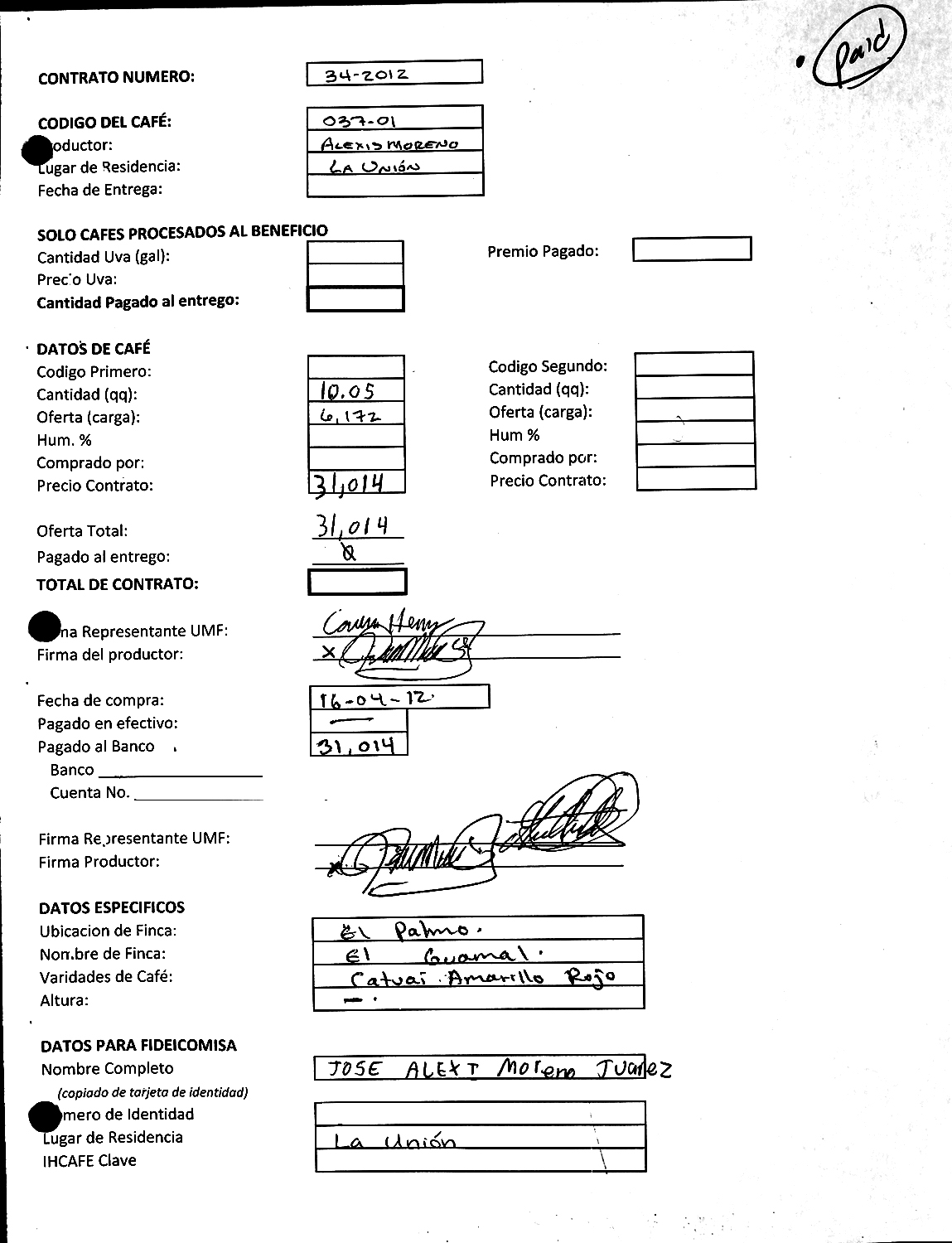
To illustrate how we purchase coffee, take a look at a sample contract (below) that we signed with Alexis Moreno. Don’t be discouraged if you aren’t fluent in Spanish. Here are the most important parts in the contract and a brief explanation of each:

  Código del Café (Coffee Code): A unique code assigned to each sample we receive.

  Cantidad (Amount): The amount of parchment coffee we purchased in qq, or quintales. (One quintal is 100 lb, so here, 10.05 qq corresponds to 1,005 lb.)

  Oferta (Offer): The rate we offer for each carga of coffee. (One carga is 200 lb, and the price is listed in the Honduran currency, Lempira. Here, 6,172 Lempira is equivalent to about $325 -- which means we’re offering $325 per 200 lb. of coffee.)

  Precio Contrato (Contract Price): The total price paid to the farmer -- the amount of coffee purchased multiplied by the rate offered. (Oddly, the standard practice is to list the amount of coffee in quintales, or multiples of 100 lb, and to make the offer per carga, or 200 lb. It’s a confusing system, and we didn’t invent it. The contract price takes this difference into account.)

  Firma (Signature): This contract was signed in UMF’s La Unión office by Alexis and Charlie Heins, UMF’s Financial Accounts Manager.


coffee contract


This contract is just one of the 44 contracts signed with 31 farmers. It’s an example of the only sort of transparency that we consider to be complete. We know exactly how much each farmer is being paid for their coffee because we are sitting at a table with them when the contract is signed; there’s nobody else in the middle.

Without further ado, here is UMF’s 2011–2012 Coffee Transparency Information:


There are a few parts of this document which may need more explanation. A mezcla is the Spanish word for “blend”—we refer to any coffee that combines more than one farmer’s harvests as a mezcla. There isn’t a price/lb green or FOB reported for any coffee that was part of a mezcla. During the parchment removal process, the amount of weight a coffee loses varies. The coffees are mixed before parchment removal, so there isn’t a way to accurately state the processing loss that occurs for each farmer’s coffee. We use the sum of all contracts and the total amount of green coffee to calculate the average amount that all farmers were paid. This prevents us from reporting green prices for individual farmers whose coffees are part of mezclas—there just isn’t an accurate way of doing so.

Another peculiarity is the lack of price/lb parchment for Mezcla #8. Coffee can only be exported from Honduras in 151 lb sacks. Typically, the amount of green coffee isn’t an exact multiple of 151. (For example, after processing, the amount of coffee we purchased from Rigoberto Paz came to 3,739 lb. We shipped it in 24 sacks for a total of 3,624 lb -- 115 lb short of the total he sold us.) Mezcla #8 is comprised of this leftover amount from all of the microlots. The green price is calculated using a weighted average of the amount of coffee from each farmer that went into Mezcla #8 and the green price of that coffee. It’s an estimate, but it’s as close as we can get to an exact price for the coffee.

You may notice that some farmers appear more than once on this document. This occurs when farmers sell us more than one lot of coffee. We cupped each lot separately, and if the flavor profiles were different, we kept them separated. Farmers like Bernardo Ponce appear both as a farmer who exported a microlot, and a farmer who contributed to a blend. He’s the same farmer, but he sold us two separate coffees with distinct flavor profiles.

This document represents several years of work both by UMF employees and the farmers that we work with. It’s the first time that we’ve published this information, and we ask that you understand that it’s still a work in progress. We’re already planning improvements for next year’s transparency report, and we encourage any feedback or suggestions.

That said, we firmly believe that this document accurately and transparently represents the prices that we purchased in the 2011–2012 harvest. “How much do you pay farmers for their coffee?” isn’t the easiest question—but now we’re proud to have a more complete answer.


There are several ideas that are presented in our Transparency Information that probably aren’t familiar to you if you don’t work in the coffee industry. We’ve tried to explain the basics above, but if you’d like more information—and especially if you’d like to compare our prices to those paid by other coffee buyers—please refer to the glossary below.

Price/lb parchment:
Parchment coffee is coffee that has been picked, processed, and dried, but has not yet had the shell (parchment) removed. All coffees that UMF purchases are “in parchment” since local farmers don’t have access to the equipment used to remove it.

This value is calculated as:


Price/lb green:
Green coffee refers to coffee that has been processed to remove the parchment. Removing the parchment from coffee decreases its weight, but the exact amount of this weight decrease can vary. Parchment coffee prices are rarely reported by other organizations, so we include the amount that farmers were paid per pound of green coffee that they sold us.

Since the amount of weight lost when processing parchment coffee into green coffee can vary, this number isn’t a completely accurate representation of the price we paid to farmers. For example, we paid both Antonio Castellanos and Pablo Paz (Lot #1) the same parchment price. Due to a higher processing loss for Antonio’s coffee, we were left with a smaller amount of green coffee in his lot. This means Antonio’s green price is $0.31/lb higher than for Pablo’s coffee—even though the parchment price is the same!

This value is calcuated as:


Price/lb FOB Puerto Cortés:
Of the three prices reported, this is the only one that includes money that was not paid to farmers (unless the farm is large enough that it has its own mill for export preparation and the farmer is able to directly export coffee). This price includes all transportation costs, export preparation costs, export licenses, and taxes. We include it as a reference since it’s commonly used by others. But it’s important not to confuse this price with any sort of price paid to farmers. It’s the least transparent of the prices—a high FOB does not necessarily indicate a high price paid to the farmer.

The last two words in this term, Puerto Cortés, refers to the seaport that all Honduras coffees are shipped from. You’ll encounter the term “Price/lb FOB Puerto Cortés” when comparing other Honduran coffees, but the last part of the term will be different when looking at coffees from other countries.

This value is calculated as:


Mezcla:
The Spanish word for blend. When we combine multiple farmer’s harvests into a single coffee to sell, we call that coffee a mezcla. All our mezclas are made up of coffee solely from La Unión. Since the coffee all comes from the same region, many other coffee buyers would refer to it as “single origin.” However, since our mezclas are comprised of coffee grown by multiple farmers from multiple fields, we insist on calling them blends.

Total Exp (lb): The total amount of green coffee exported by a farmer. Because the coffee used in mezclas were combined prior to the parchment removal, this number is not available for farmer’s coffee that was used for mezclas.

Wednesday, August 1, 2012

Ten Weeks Can Fly

The following post was written by our intern Ben Finan before he left La Unión:

I arrived in San Pedro Sula on May 22, only a week removed from finals at Notre Dame, with three complete strangers. Nine weeks later, I count those three strangers among my closest friends. My experience working with Unión MicroFinanza has also permanently changed my outlook on development. Working individually with UMF’s 178 loan clients introduced me to the “why” of UMF’s mission, and I thoroughly enjoyed each interaction with our clients. Each client presented a different story, a different need, and a different outlook, but it was easy to see one major similarity: all were genuinely excited to enter the loan program and begin a partnership with UMF.

Intern responsibilities shifted on June 29 with the arrival of the first Community Partnership Project group. A series of three amazing groups from different churches arrived and departed, each having a unique experience working with the community of one of the outlying villages. The group that I worked directly with, from Life Church of Fort Collins, Colorado, visited San Agustín, one of the poorest communities that UMF partners with. We worked on installing water filters while building community relationships, which was incredibly fulfilling on all fronts. Having the ability to share La Unión, which I have grown to love, with new people was the highlight of my summer.

Friday, July 27, I depart La Unión. San Pedro Sula will no longer feel like a foreign city in a far away country, but a biting reminder of how short my journey was here. In Honduras, I witnessed firsthand the outstanding work of UMF, contributed as I could, and changed my outlook on life. My support for UMF will continue in the future, but not being able to walk down the hill to the office, hear the friendly motorcycle honks, exchange pleasantries, and frequent the pulpería will be missed. This summer has taught me more in ten weeks than I could have ever imagined, and I am grateful to UMF for the opportunity to be here.


The interns hiking to San Agustín. Photo by Jeremy Miller

Friday, June 29, 2012

Microloans 100 Pounds at a Time: The Distribution Process through Pictures

Introduction by Ben Finan
Photo Journal by Natalie Clark
Photos by Lennie Zhu and Heather Farrell


May 23, the first day for the newly imported interns in the Honduran UMF office. As became a common occurrence, Patrick began talking coffee even before we walked through the door. We quickly learned the importance of proper fertilization, and the massive role that we would soon play in the distribution of microloans to our clients. 

Within the week, we would begin calculating qualifying loan amounts for clients and processing the nearly 200 requests for loans that we received from the twenty-three aldeas surrounding La Unión. By June 1, we had approved 171 clients for a total of 1156 bags of fertilizer. Personally, I had no idea that there were nine different types of fertilizer for coffee, let alone the exact names of them. 

By the following week, I had become intimately familiar with all of the bags, with five of us carrying each of the one hundred pound bags off of the delivery truck and into the warehouse that would become our new center of operation for the coming two weeks. In a blur, the countless names that the four interns had become so familiar with while processing the mountain of paperwork became living, breathing, inevitably smiling (and sometimes quite entertaining) clients sitting in our office, signing paperwork and loading their yearly supply of fertilizer into their pickup trucks. 

We watched them drive off, trucks buckling under the weight of the fertilizer, heading out to work on the coffee that we will soon enough begin to process at our beneficio and some of which we will purchase in six short months. Thus far, UMF has exhibited a forty percent increase in microloans from 2011, with more loans still to come. It has been a whirlwind of a week for the interns, but we are looking forward to more to come!

The pictures below follow the distribution process, capturing the intern experience and just some of the people and paperwork (there was a lot) involved. 


Photo by Lennie Zhu

Fertilizer loading and unloading is an all-hands-on-deck sort of process. Between the UMF staff, interns Ben and Dillon, and occasional paid hands at the rented warehouse, 1156 bags of fertilizer were unloaded from the semi-trucks and stacked in the warehouse. A certain rhythm developed, as one person would help the other flip the bag onto his back. Lennie and Natalie kept busy documenting the process with pictures and keeping count of inventory.


Photo by Lennie Zhu
After plenty of sweat, dirt, and an injury or two, the bodega (a warehouse) was filled. Seeing so many stacks of bags and knowing that each would have to be distributed and accounted for impressed upon us all the immensity of the task ahead of us over the next two weeks.

Photo by Heather Farrell

The first step of our fertilizer distribution process began in the office with computers and piles of paperwork. We had spent the past few weeks assembling our client’s paperwork and calculating loan approval amounts. Ben has become the master of the spreadsheets and is an integral component of the process, checking each farmer’s order request and qualified loan amounts against our inventory totals.

Photo by Heather Farrell

After checking totals on the computer, there is (of course) more paperwork. A libreta (a small booklet) is filled out for each client documenting this loan of fertilizer. The clients then bring their libretas with them to each loan meeting in order to track repayments and attendance through the twenty-three meetings over the next ten months. 

Photo by Heather Farrell


For those clients who are unable to sign their names, a fingerprint functions in its place. Literacy is an issue in many of the aldeas, with the average education level of our clients being completion of the third grade. Here the client displays his ID, presses a finger to the ink, and signs the paperwork via fingerprint. 

Photo by Heather Farrell


With paperwork complete, albeit temporarily, our clients pocket their libretas and drive their trucks across the street to the front door of our bodega where the fertilizer bags are stored.

Photo by Lennie Zhu

We take security seriously here in La Unión. The bodega is guarded by a huge, terrifying dog constrained by a thick chain during the day. There was a funny moment the first morning as Gilberto, one of UMF’s Honduran employees, growled and grabbed Lennie’s ankle. She screamed and jumped a foot. One thing is certain, nothing is getting past that dog. 

Photo by Lennie Zhu

Martir, one of UMF’s Field Officers, seems to be everywhere at once throughout the distribution process. Martir, Gilberto, and Pedro alternate helping to fill out loan paperwork with clients in the office, checking orders with them in the bodega, helping load fertilizer into trucks, and keeping tabs on our inventory totals. Here, Martir balances amidst the fertilizer stacks, recalculating inventory amounts. 

Photo by Heather Farrell

Reinaldo Mejia Hernandez, a fist year client from Gualciras, displays his libreta as his fertilizer order is loaded. Clients use their libretas to confirm their numbers with our paperwork, ensuring that they receive the appropriate type and quantity of fertilizer. 

Photo by Heather Farrell

Pedro Mejia, a prominent second year client and coffee producer from Gualciras, carries one of his bags of fertilizer to his truck. Everyone lends a hand loading fertilizer for the clients, as Natalie keeps track of inventory sheets, checking that the fertilizer leaving the bodega matches what is listed. 

Photo by Heather Farrell

After the fertilizer is loaded, Natalie confirms the fertilizer totals with each farmer, assuring that they receive exactly what was ordered, and finally the farmer signs to mark the order complete. 

Photo by Heather Farrell


Angel Hernandez, a second year client from Gualciras, puts on the finishing touches, packing down his fertilizer as he prepares to depart. With many a “que le vaya bien,” we wished him well on his way and watched as he drove off down the dusty dirt roads with a truck full of fertilizer and full of energy and enthusiasm for his coffee harvest. 


Friday, June 22, 2012

Don Tejada: A Big Step Forward


Jose Adonil Tejada signing his loan forms and by his car

Jose Adonil Tejada stepped into our office with a quiet smile on his face. It was clear, though, that he had come with a purpose. He had arrived to discuss his loan of a molino, or corn mill, valued at 18,000 lempira. Our goal for the meeting was to talk over his plans and establish a schedule for repayment that would give him enough flexibility to grow his new business at the same time. 

The most incredible part of working with him was watching his mind work as he outlined his business plan with us. He explained that his clients would come to him with their corn for processing and that his family would then return the produce to them in the form of usable flour. He intends to charge clients one lempira per pound and expects daily revenues of L. 2 per family, thus generating a revenue of about L. 600 each month from it. Martir, one of UMF’s senior field agents, and I alternated between questioning him about how many clients he expected to have, what expenses he would have when running his business, and at what times during the year he expected to generate the greatest amount of revenue from this new endeavor. Don Tejada looked us straight in the eyes and answered all of our questions thoroughly. It was quite clear that he had already thought through many of these details, and our calculations revealed that it would indeed be a profitable business for him. In a society in which the simplest concept of saving money for future investments is still quite obscure, it was immeasurably exciting to hear about his plans and feel confident in his and his family’s ability to not only pay back the loan, but significantly improve their own lives. 

This loan marks an important milestone for Unión MicroFinanza. UMF’s goal has always been to provide the vehicle through which members of La Unión’s community can drive their own sources of livelihood. While fertilizer loans are helpful for farmers, UMF’s dream is for its clients to remain with us for enough years to finally build up enough credit to begin taking out substantial capital loans such as this one. In this way, they will be able to expand their businesses in a way they truly could not have in the past. Once Don Tejada pays off his loan for the corn mill, his family will have an entirely new source of revenue—one that will not only bring added security to them, but will also lend itself to increased opportunities for further investments in the future. As more clients begin to take out capital loans for mills, solar dryers, and other processing equipment, we are hopeful that we will be able to observe a significant leap in their businesses and in the communities in general. 

As an intern, I feel extremely lucky to be working with UMF at this critical moment and look forward to seeing Don Tejada again. My hope is that the next time we meet will be in La Ceibita Centro, at the site of his successful new corn processing business.

Written by Lennie Zhu
Photos by Lennie Zhu

Monday, June 18, 2012

Community: In Theory and in Practice


¡Hola! I'm Dillon, a sophomore at the University of Michigan and one of four UMF interns living in La Unión this summer.  Getting to know the other interns and the UMF employees has been very interesting, and I already feel a part of the UMF family. Whether it's jabs at my Notre Dame-attending roommate, Ben, for his school's inferior football and basketball teams (in the humble opinion of a Michigan Wolverine), in-depth philosophical discussions with anyone around on whatever topic of the day, or losing the dictionary game to Jeremy at the Comedor during lunch, the sense of fellowship here is extremely high.
And although this intra-organizational camaraderie is important, much more importantly, and impressively, is the togetherness between all of the UMF workers and the community of La Unión. I've volunteered with UMF for about the past year, so I've known for a long time that one of UMF's core values is to be a part of the communities that they partner with. However, it is one thing to know this value and another to see it lived out and be a part of it each and every day. I see this in practice in countless ways. When I walk down the street with Charlie it seems like every La Unión child below the age of 13 comes outside to yell "Carlitos!" Each time I've been over to the UMF house/office for dinner we've been joined by one or two of the kids from the local bilingual school, who are always encouraged to stop in. I've played volleyball with Hondurans, eaten dinner at their homes, gone to their church, and even have plans to make a cake later this week with a class of 3rd graders.
I am a firm believer that poverty is not strictly a monetary issue and am so proud that the organization I am interning with is not just a money-in, money-out microfinance institution for this reason. Poverty alleviation does not come about from simply increasing access to financial services, it comes from an all-encompassing approach which UMF offers. It's facilitating Community Partnership Programs from the United States–of which we are hosting multiple this summer.  It's partnering with the local bilingual school–the interns are going this week to speak with the 10th graders about university in the U.S.  It’s living within the population and conducting development in a way that is community-driven.  I’m excited to continue to be a part of this philosophy, and more excited to live it out each day.
¡Hasta luego!

Outside the Catholic Church in La Unión


Written by Dillon Horne
Photo by Lennie Zhu

Saturday, June 9, 2012

A Week of Baleadas


This is my first time spending an extended period of time in a developing country, and I’d be lying if I said that life isn’t that different. There have been a lot of changes to adjust to, yet despite some of the challenges, it’s been well worth it for the amazing experience, the people I’ve met, and the many things I’ve learned already. We were picked up at the San Pedro Sula airport by Jeremy Miller, UMF’s Director of Honduran Operations, and Albin, our head of security, a Honduran man who we soon learned was both incredibly tough and very kind. During our three hour drive to La Unión, careening across lanes and maneuvering the hilly, potholed dirt roads with ease, he showed us pictures of his three children, the pride and love evident in his voice. 

Though the roads became worse the further we drove, the scenery and mountain views became more and more spectacular. In town the roads are all dirt (and, after a rain storm, all mud) and filled with holes and rocks. Walking down the street is always a challenge to find the least muddy route and to avoid the dogs, chickens, horses, motorcycles, trucks, and other passerby that are always traveling every which way. The houses are small and pretty, painted in bright shades of pink, yellow, and aqua. There are lots of flowering trees, and, of course, the constant views of the beautiful verdant mountains surrounding the village. 

I quickly learned to consider it a luxury rather than a fact of life to have both water and electricity at any given time. During my first week, there was one night when the water ran out mid-shower, and then the next night the power went out, leaving the shower pitch black. We learned to judge the usability of the water by whether washing with it would leave us cleaner or dirtier than we were before bathing. Cold showers are perfectly acceptable here, the question being whether our temperature choice would be icy, cold, cool, or, once in a while, lukewarm.  
   
Food too is always an adventure. At the airport I had my first baleada, a classic Honduran meal consisting of a tortilla filled with a combination of eggs, beans, cheese, avocado, and mantequilla (a mayonnaise-like sauce). It was really tasty, though baleadas were much less exciting when they became the standard daily lunch. At our local comedor (a small eatery), I eat a baleada for 10 lempira, the equivalent of a 50 cent lunch. Liquados are among my favorite food finds. Similar to the consistency of a frappacino, liquados are blended drinks made with ice, fresh milk, and whatever fruit is available, pineapple and watermelon are common at the present. I love being able to buy peeled and halved oranges at the fruit stand on the corner, and it’s become a part of my daily routine. 

Like anywhere, some people are more friendly than others, but, overall, the people we have met have greeted us with smiles and generous hospitality. Walking down the street we always greet the people we pass with a “hola,” “buenas,” or “adios.” Interestingly, I learned that “adios” can be used as a greeting for both hello and goodbye. Honduran children will often greet us with giggles and a series of “bye byes,” using the literal English translation. On our weekend trip to Gracias, a city about three hours south of La Unión and four times the size, I noticed that there were far fewer friendly greetings exchanged. The other interns and I appreciated the friendliness of our small town even more after comparing it to the “big city.”

There have been many changes to adjust to living in La Unión, but as we enter our third week here, I feel comfortable and at ease. Ben, Lennie, Dillon and I keep busy researching and assisting the Unión MicroFinanza staff and have enjoyed exploring the town, chatting with locals, and playing cards together in our free time. These first couple weeks have been great, and I am eager to learn more, continue to absorb the culture, and maximize the experience.

Standing on a rooftop in Gracias


Written by Natalie Clark
Photo by Lennie Zhu

Friday, June 1, 2012

Orlando: A Story of One and of Many


I saw Orlando today. He looked great. Happy. Vibrant. Gracious. He was Orlando as I knew him. It was beautiful to see my friend again. Though he had visited multiple times per week during the previous month, it had been too long since I had seen the real Orlando.

Just a month ago, he sat in our office devoid of life. His eyes were sunken and red, sorrow and fear dominating his emotions. This was not Orlando. It was obvious he hadn’t eaten or slept well in days. As we listened to him speak about the struggles facing his family and community, the worry in his voice was evident. He needed help. 
It was at that point we realized the situation in Chimizal was becoming desperate and that, if we didn’t intervene, no one would. After our conversation, Orlando made the hour-long trek back up the mountain from La Unión to Chimizal. He collapsed en route under the mid-day sun. It had taken his last ounce of strength to reach out one more time to his final hope for help.
Orlando’s reality was but one among far too many desperate situations in the villages surrounding La Unión in the weeks following the hailstorm of April 2, 2012. The resulting food crisis pushed these people, already living on the margins, over the edge. No matter how hard they worked, the huge obstacles they faced could not be overcome. 
Fortunately for Orlando and the people of Chimizal, San Agustín, and Lepagual, a community of people led by Michelle Noordhof, METAD, and their donors embraced these villages and saw that they didn’t have to suffer, for there were those capable of offering a hand in their time of need. This group of people showed the humanity that is oftentimes elusive in our world. Their initiative made all the difference at this critical moment in the life of Orlando, and that will never be forgotten.
Now there is again hope that better times may lie ahead. Fields are once again being tended, and the bean harvest is a mere 70 days away. The food aid that is being delivered will serve as a bridge through these tough times. Though Orlando lives in poverty by any economic measure, he feels rich today, and it shows. 
Orlando is smiling again. Thank you to everyone who helped ease the suffering of a deserving people. It was truly appreciated in ways I am unable to express.


Orlando Cantellano


Written by Jeremy Miller 
Photo by Lennie Zhu